
Where the odd ones came from
Dandini is one of those traditional pantomime character names every group uses and nobody questions, which has always struck me as odd for a role that once carried an entire second act. I've sat in rehearsal rooms where a cast has cheerfully played Buttons, Widow Twankey and King Rat for six weeks without one person asking why any of them are called that, and Dandini gets the same free pass in our own Cinderella. I've therefore done the research (so you don't have to!) and the answers turn out to be better than the question deserves. Several of these names are jokes that stopped being funny around 1890, one of them is a tea, and one of the most famous of the lot was borrowed from a completely different fairy tale by a Russian ballet company.
Dandini, the Prince’s Valet Who Never Went Home
Dandini comes out of opera rather than pantomime. He appears in Rossini’s La Cenerentola of 1817 as the Prince’s valet, and the plot turns on the two men swapping clothes so the Prince can look at the guests without anybody looking back at him. Rossini’s joke is that Cinderella turns down the man she thinks is royal and falls for the one she thinks is the servant.
British pantomime took the character, kept the name, and quietly dropped most of the reason he was there. In a lot of modern versions Dandini is simply the Prince’s friend who announces things, which is a considerable demotion for a man who once carried the entire second act. In our Cinderella he’s one of 11 principal characters, and he keeps enough of the Rossini mischief to be worth casting properly rather than handing to whoever’s left.
Buttons Was Invented to Keep Dandini Company
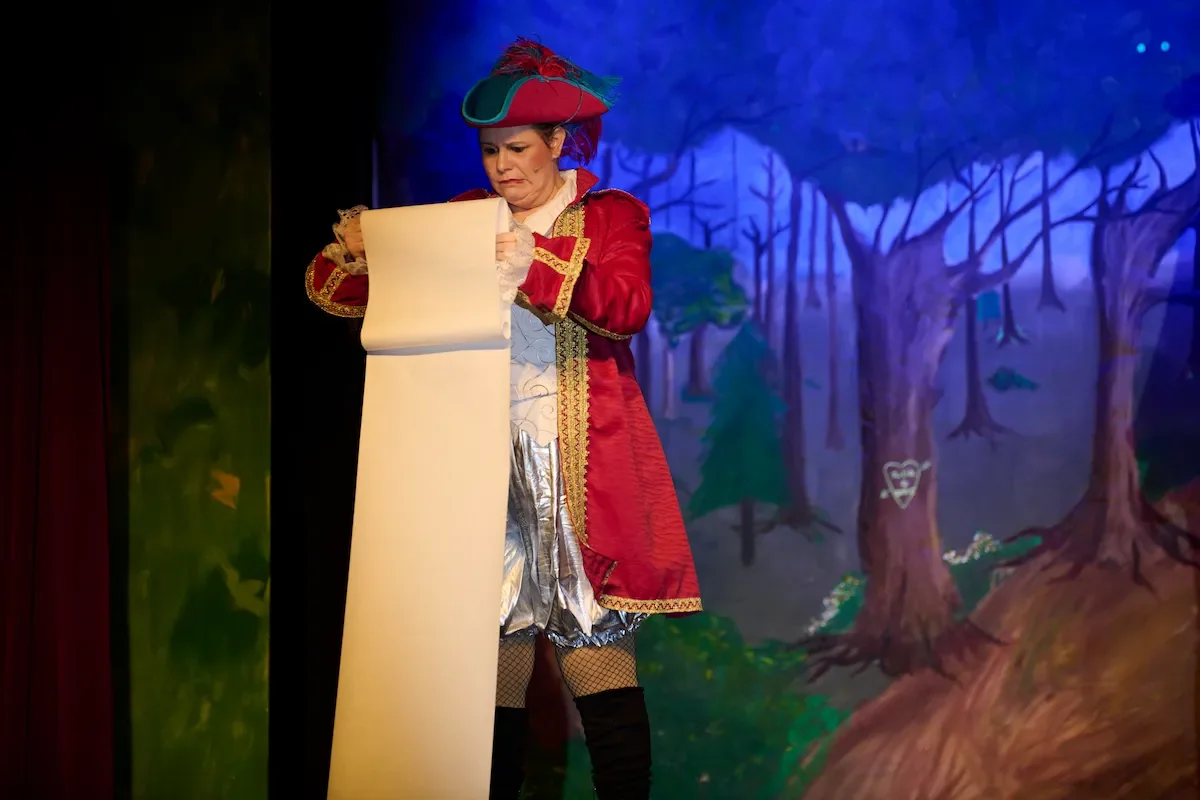
Buttons is younger than Dandini and exists partly because of him. The character first appeared in 1860, at the Strand Theatre in London, in a version of Cinderella drawn from the Rossini opera. Somebody sensibly worked out that if the Prince had a comic servant then Cinderella needed one too, and Buttons arrived under the Italianate name ‘Buttoni’ to match. He then spent years being called Chips, Alfonso and Pedro before the name settled.
The name itself is a uniform. A Victorian pageboy wore a jacket with close-sewn rows of gilt buttons down the front, and ‘Buttons’ was ordinary slang for the boy inside it. So one of the best-loved comic roles in pantomime is named after his workwear, which is the same logic that gives us a Dame called Sarah the Cook in Dick Whittington.
Baron Hardup, in the same story, is doing exactly what his name says. He’s skint, he’s being chased for rent, and the name saves the writer a page of exposition.
Widow Twankey Is Named After a Tea
Widow Twankey was first played by James Rogers at the Strand Theatre on 1 April 1861, in H. J. Byron’s Aladdin or The Wonderful Scamp, which is the production that fixed most of what British audiences now think of as Aladdin. Twankay was a popular tea at the time, shipped from the Tuon Ky region of China. Naming a laundress after a fashionable tea was a topical gag, and it has outlived everybody who found it funny.
Wishee Washee, her other son, is named after the laundry itself. The spelling matters more than it looks. Most people searching for him online type ‘wishy washy’, which is the common modern misspelling, but Wishee Washee is the older form and the one he was actually given. In our Aladdin Widow Twankey runs Twankey’s Launderette and Wishee Washee works there, which keeps both jokes intact rather than leaving them as names with no cause.
The Villains Have the Strangest Histories
Abanazar is not in the Arabian Nights. The magician in the original tale has no name at all. He was billed as ‘The African Magician’ in a harlequinade of 1788, and got his name in Charles Farley’s Aladdin or the Wonderful Lamp at Covent Garden in April 1813. Byron’s 1861 version then made him evil and funny at the same time, which is still the setting most groups play him at.
King Rat, in Dick Whittington, is almost certainly a pantomime invention rather than anything from the Whittington legend. Panto needed a demon king to oppose a good fairy, the legend supplied neither, so the form built both. Rats were an easy sell in a city that had watched the Great Plague go through it, and Samuel Pepys records seeing a Whittington puppet show only three years after the worst of it. The cat, incidentally, looks like an invention too.
Carabosse is the one most often got wrong. Perrault leaves the uninvited fairy unnamed in 1697, and so do the Brothers Grimm. The name belongs to a different story altogether, Madame d’Aulnoy’s The Princess Mayblossom, and it reached Sleeping Beauty when Petipa borrowed it for the Tchaikovsky ballet in 1890. It’s been the standard name ever since, which is why our version uses it, but it’s a ballet import rather than a fairy tale one.
Fleshcreep, who works for the giant in many versions of Jack and the Beanstalk, is a late addition. (Our version has Mrs Blunderbore instead!) The giant is the old part. Blunderbore comes out of Jack the Giant Killer, where Jack strangles him, and he has also been Blunderbuss, Blunderboer and Stoneheart depending on who was printing the chapbook.
The Names That Are Real People
Alderman Fitzwarren is the only name here belonging to somebody who actually existed, more or less. Richard Whittington married Alice FitzWaryn in 1402, and her father, Sir Ivo FitzWaryn, is where the pantomime’s Fitzwarren comes from. There’s a great deal more to the real man than his surname, and I’ve told it properly in The Real Dick Whittington blog post.
Dame Trott is a joke that has aged out of recognition. ‘Trot’ was an old dismissive term for an elderly woman, so calling Jack’s mother Dame Trott was a bit like calling her Old Biddy. She turns up as Dame Durden in some versions instead.
What We Do With Them, and What We Do Not
None of these names are ours, and none of them belong to any one writer. They are the shared furniture of the form, and a group performing a version of Cinderella that has Buttons in it is joining a queue that started in 1860. If you want the fuller chronology these names all sit inside, from Roman dancers onward, I’ve written that separately in The History of Pantomime.
Where a story doesn’t hand you a name, you have to invent one, and that’s where a catalogue starts sounding like itself. Beauty and the Beast has no traditional Dame at all, so ours is Dame Dotty Doolally. Rapunzel has no traditional Dame either, so ours runs a hair salon and is called Dame Betty Beehive, and there are more hair jokes in our script than is strictly defensible. Alice in Wonderland gets Duchess Battenberg, using the Duchess that Carroll already left lying around, because a cake pun was too good to pass up.
Peter Pan doesn’t hand you one either, since J. M. Barrie never wrote a Dame into the story at all, so ours solves it the way several other companies do, by making Smee the Dame rather than inventing somebody from nothing. There’s no single fixed dame in the traditional Robin Hood or Pinocchio stories either, so we’ve used our creative licence to adapt existing character names to create Dame Wilma Scarlet and Dame Geppetto respectively. You can meet Dame Geppetto and the rest of the Pinocchio cast in our Pinocchio pantomime characters guide.
And where the tradition offers a name that works, we keep it, which is why Widow Twankey is still Widow Twankey.
Reading the Names in Context
Names on a page tell you very little about whether a part is worth casting, so reading a free Perusal Script is the best way to find out more. Our full list of scripts shows cast sizes and running times for every title, and the home page has other helpful links. When you’re ready to book your chosen panto script, the Performance Licences page sets out how to do it.