
Alice in Wonderland Pantomime Characters: A Complete Guide
Who's Who Down the Rabbit Hole
The Alice in Wonderland pantomime characters in our version are organised around a joke the audience is taught in Act One and then uses to solve the plot in Act Two. Duchess Battenberg loses a bet over a faulty icing bag, the house learns to shout 'It's a piece of cake!' whenever she asks how something is done, and by the final scene that shout is what hands Alice the idea that stops the Queen of Hearts. That tells you where the weight of this show sits before you cast a word of it. Every named character follows, with what each part needs.
Alice and the White Rabbit
Alice arrives in Wonderland having followed the White Rabbit down a rabbit hole and interrupts the Wonderlanders as they set the scene for the Audience. As in Lewis Carroll’s original , Alice carries the story and the emotional arc, and is the central theme that everything else fits around. She also holds the heart of the story when she returns to Wonderland to save everyone from the wicked Queen of Hearts and does so with the Audience’s help. Cast someone who can play that quietly, because a big performance will flatten it.
One thing to settle before auditions rather than after. Alice shrinks in the bakery scene and is replaced onstage by a child in a matching costume, with an alternative in the Author's Notes for companies with no children in the cast.
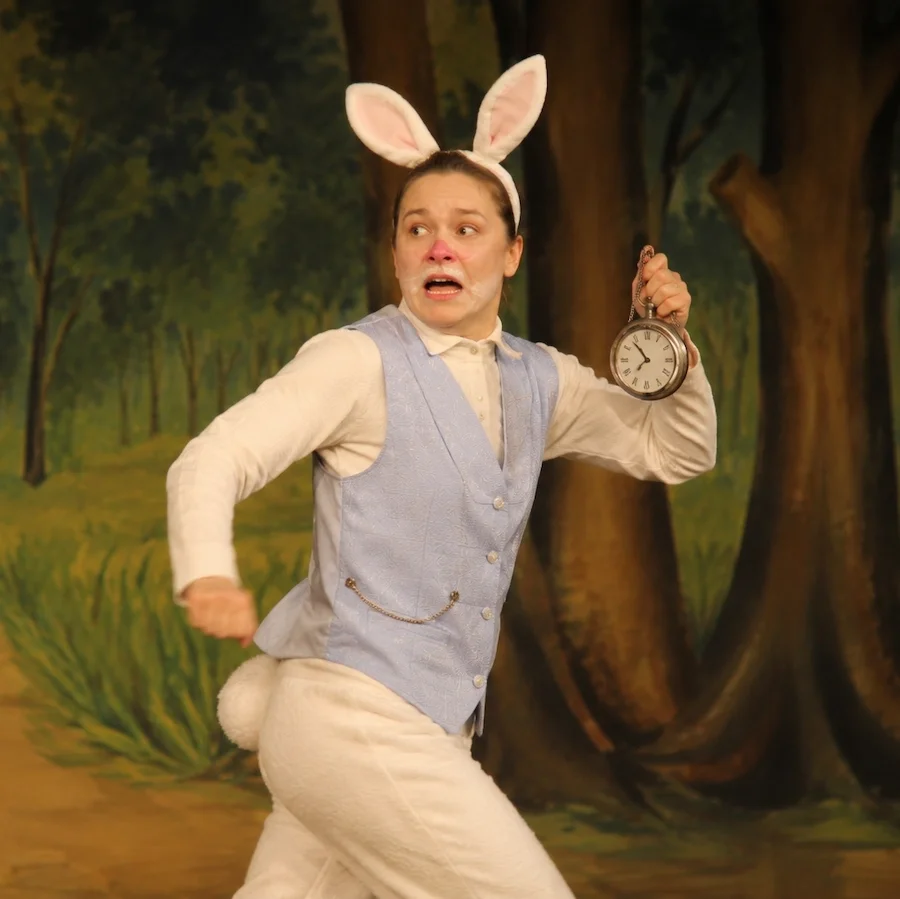
The White Rabbit is flustered, permanently behind and cheerfully unbothered by it, describing himself as 'reliably late. There's a difference.' He's Alice’s way through Wonderland and the closest thing she has to a friend. Together they make the spine to the story, so it’s recommened to cast the other characters around them where possible.
Duchess Battenberg
Giving the Dame a job rather than just a frock is common across pantomime, and here her trade carries more than the jokes, because the Royal Bakery supplies the catchphrase, the slosh scene and the object that ends the plot. She opens on her un-birthday, admits she isn't a real Duchess because 'my mother got a bit enthusiastic on my birth certificate', works the front row for a husband, then loses a long fight with a double-ended icing bag that only ever works for the King. It’s a very silly scene that can get very messy if you’re up for that, or can be contained with a bit of practice.
Duchess Battenberg anchors the ghost scene too, by insisting throughout that ghosts don't exist while everyone else is chased off around her. The reversal, where the ghost gets a proper look at the Dame and bolts, is the traditional shape of that scene, and ours belongs to a baker who was technically right all along.
The Queen of Hearts and the King of Hearts
The Queen of Hearts comes with the source material, and we've given her a specific frustration to act on instead of general tyranny. Her execution orders keep being commuted by her husband, which she complains has made beheading 'less of a punishment and more of a strong opinion', so she goes hunting for a Jabberwocky. She wants something permanent that the King can't undo, which gives a villain something to want rather than a mood to sustain.
It also gives the King a job worth casting properly. He spends most of the show as a timid interrupter and the willing straight man in the icing routine, then crosses the stage in Act Two to stand with the Wonderlanders and is arrested for it. The Queen's ending is a real turn, softening in front of a small monster with puppy-dog eyes and leaving as the Queen of Melted Hearts. You want someone who can ramp up the villainy for two acts of booing and still play the last two minutes straight.
Tweedledum and Tweedledee
In a slight departure from tradition, the Tweedles work for the Queen by accident rather than loyalty, which is the joke. Everything they do comes out contrariwise, so she has to reverse her own orders to get anything from them, instructing them that under no circumstances are they to search for Alice. Sent to make an arrest in Act Two, they handcuff themselves to each other. Two performers who can hold a straight face through an argument about whether left was right or correct, will get far more from this than a pair playing standard henchmen. They're not baddies, rather a bonkers duo who obey the Queen out of confusion and contrariwise logic.
The Cheshire Cat
The Cheshire Cat narrates in rhyming couplets, opens the show before the tabs do, and spends the evening watching from the side and quietly making things worse. A rhyming guide who bridges scenes turns up elsewhere in the catalogue, the Spirit of Sherwood does the same job in our Robin Hood script, but this one has a device the others don't. When Alice steps through the Looking Glass into the ordinary world, the Cat follows and her rhymes stop working. The place looks 'a mass' rather than a mess, and she isn't invisible but 'invis'. Back in Wonderland the couplets are clean again. The part needs sustained direct address and the confidence to deliver a bad rhyme on purpose.
The Mad Hatter, the March Hare and the Dormouse
The tea party runs on one gag played with total commitment. The Hatter offers everything and has none of it, and asked why he bothers, answers 'Because it's polite.' He can't get Alice's name right either, working through Alicia, Alison, Alan and Archibald, and that one runs to the walkdown, where he calls her Anastasia and the whole company corrects him. The March Hare is the nearest thing the scene has to a sensible person. The Dormouse sleeps through most of it and wakes twice, once to name the Jabberwocky and once to say what nobody else will, that Alice has to go home. A small part holding two of the plot's hinges.
The Caterpillar, The Ace of Hearts and the Jabberwocky
The Caterpillar meets Alice once in each act and both times asks who she is, refusing her name and her facts as answers. It's a few minutes of stage time that the whole of Alice's story hangs from, and it suits someone who can be still while the rest of Wonderland is frantic.
The Ace of Hearts heads the Queen's Guard, and his best scene is a casualty report delivered entirely in card numbers, in which the Jabberwocky ate the eight, Seven didn't make it and the Four bit the dust. That routine wants clean timing rather than a big character, and it falls apart if it's rushed.
The Jabberwocky is built up all evening as something unspeakable, then arrives having eaten a slice of the Duchess's cake, which works on it contrariwise. What turns up is a cute dragon that would like a tart, and it can be played by a child. With the shrunken Alice, that is two featured moments for younger members of a youth group.
The Card Guard
The Aces of Clubs, Diamonds and Spades bicker over which suit outranks the rest in a scene built almost entirely from card puns, and the Two and Three of Hearts arrive to paint the roses red carrying a bottle of rose wine and a box of chocolates, on the understanding that the Queen wants the Roses read. These five suit confident performers who want something to play without learning a principal part, and the full character breakdown lists them all.
Casting the Alice in Wonderland Pantomime Characters: Who It Suits
Alice in Wonderland runs to 14 principal characters and five supporting roles, plus an Ensemble playing cards, citizens, guards and ghosts, which puts it among our pantomime scripts for large casts. It also sits with our unusual pantomime scripts, so an audience arrives with no fixed idea of what ought to happen next and your Queen of Hearts gets to surprise them. Anyone still narrowing a shortlist can browse the All Scripts page, and our home page opens onto the rest of the site.
Two of the largest parts, the Dame and the Cheshire Cat, talk to the house all evening, so read their scenes before you cast either. A free Perusal Script gives you the whole thing, and the Alice in Wonderland script page has the running time and the scene list. Our Performance Licences page deals with booking, and the FAQs answer most of what comes up first.