
The History of Pantomime
The history of pantomime is a properly daft story that runs from Roman dancers to an Act of Parliament, which isn’t a sentence I ever expected to write down. I write pantomimes and I’ve spent a good few Decembers in the pit under one, so I’ve read more about this than is strictly healthy, and these are the bits that stuck.
Italy First, Then a Man Called Lun
A pantomime, in the British sense, is a family musical comedy built on a fairy tale and staged around Christmas, with a Dame played by a man, a villain to boo, and lots of audience participation. It’s a show for everyone from ages 3 to 103, and it brings joy and laughter to audiences across the UK and beyond every festive season.
The word itself comes from the Greek pantomimos, a performer who played all the parts, which is why in many other countries pantomime still means a largely wordless performance, and only here does it mean a man in a frock and a two-person cow.
The Italians gave us the characters. Commedia dell’arte ran on stock characters an audience recognised on sight, among them Arlecchino, who became Harlequin once he got here, and Pantalone, the pompous old man who turns up in our scripts as whichever Baron or Mayor is having the worst evening. England had already supplied half the job itself. The Mummers Play, a Christmas folk tradition stretching back to the Middle Ages, already carried stage fights, coarse humour, a man dressed as a woman, and good beating evil in the last five minutes, which is most of a modern panto’s second half before anyone had written a script for it. One of the first attempts to turn any of this into English stage entertainment flopped: John Weaver, the dancing master at Drury Lane, tried it around 1702 and nobody remembers the name of the show. History gave the credit to the man who came second instead, which is a little unfair on the one who tried first. Harlequin became a star properly in 1717, when John Rich put him on at Lincoln’s Inn Fields under the stage name Lun, short for lunatic, and this time it worked. His 1724 production, The Necromancer, confirmed the fashion was there to stay. Rich’s Harlequin carried a batte, a wooden bat he struck against the scenery to knock down a hinged flap and change it, and the prop gave its name to slapstick comedy.
Why the Early Shows Hardly Spoke
Two dates matter here, not one. In 1737 Parliament restricted spoken drama to theatres holding a royal patent, Drury Lane and Covent Garden chief among them. Everyone else had to find creative ways around that rule for over a century, which is a large part of why dancing, mime, music, and spectacle mattered so much to early pantomime. When the Theatres Act 1843 finally ended that monopoly, the rest of the country could put a spoken play on stage legally for the first time.
You’ll see this stated the other way round, as though 1843 lifted a ban on speech altogether, which is backwards. Drury Lane and Covent Garden had been talking since 1737 without needing anyone’s permission. What changed in 1843 is that everyone else was allowed to join in.
Fairy Tales, Clowns and a Great Many Puns
Somewhere in the early 1800s the classical subjects gave way to fairy tales and nursery rhymes, which is where the modern shape of the thing starts. Joseph Grimaldi was busy pushing Clown ahead of Harlequin at the same time, and greeted the transformed set with ‘Here We Are Again!’, which is roughly the energy every Dame entrance has been going for ever since.
Then the Victorians got hold of it. James Planché and Henry James Byron put puns and wordplay at the front of the form and nobody has managed to prise them out. Byron’s Aladdin of 1861 fixed most of the shape that title still has, our Aladdin script included, which I’d feel worse about if the puns weren’t so good.
The Dame Is Older Than Dan Leno
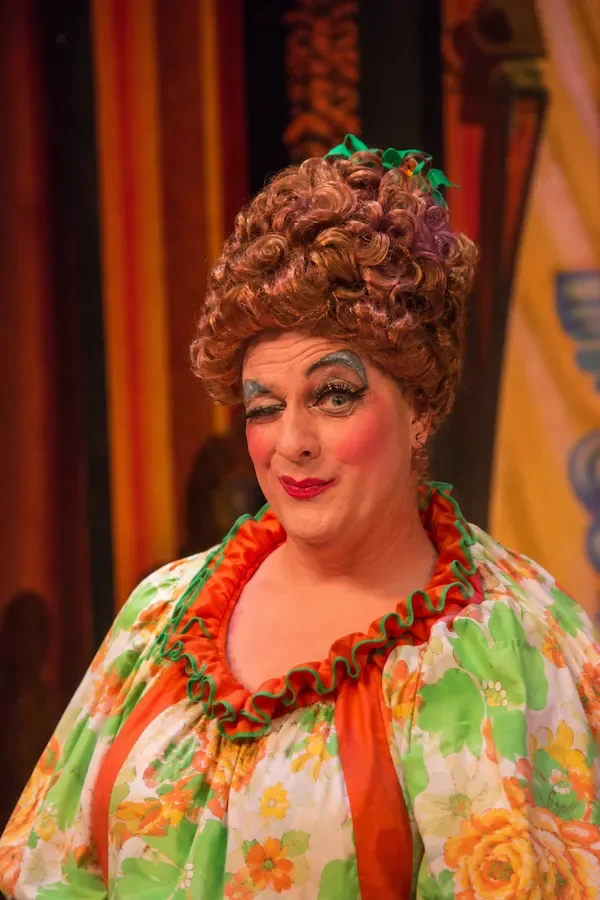
She didn’t come down from Pantalone, whatever you may have read. She isn’t Dan Leno’s invention either. Men had been playing comic older women on the English stage for a long time before he arrived. Samuel Simmons played the title role in Harlequin and Mother Goose at Covent Garden in 1806, 80 years or so before anyone had heard of Leno, in a production with Joseph Grimaldi himself playing Clown.
What Leno did, starting in 1888 and running for around 15 years until shortly before his death in 1904, was turn an already-established convention into something much bigger. Mother Goose, 1902, was written for him, and his bun-wig, shawl, and button boots are still the template, so every Dame since has been doing a version of Dan Leno whether she knows it or not. There’s a good deal more to say about her, and I’ve said most of it in a separate guide to the pantomime Dame.
Leno wasn’t working alone, either. Augustus Harris, running Drury Lane in the same years, hired him as one of the first in a long line of famous names brought in to draw a crowd, which makes the guest star on this December’s poster a Victorian marketing idea rather than a modern one.
And Then What Happened
The last harlequinade was played at the Lyceum in 1939, and Harlequin finally bowed out, leaving the pantomime everyone now recognises, which has done rather well out of the arrangement. One study puts it at around a fifth of all live performances in the UK in any given year, the 2018 to 2019 season took over £60m for the first time on record, and in 2016 it overtook comedy as the genre filling the most seats in British theatres. The five best-attended titles that year were Cinderella, Dick Whittington, Jack and the Beanstalk, Aladdin, and Beauty and the Beast.
It’s still happening. Since the London Palladium revived their pantomime extravaganza in 2016, they’ve been through various titles including Sleeping Beauty, Peter Pan, and Goldilocks and the Three Bears. In December 2026 the London Palladium’s panto is Cinderella, with Dawn French and Jennifer Saunders reuniting as the Ugly Sisters, the latest names in a celebrity-casting tradition that runs back to Augustus Harris hiring Dan Leno in 1888. There’s more on how that story unfolded, and on the Palladium’s own up-and-down history, in Pantomime Traditions.
All of the above titles are in our catalogue along with more up-and-coming titles such as Rapunzel, Hansel and Gretel, and The Little Mermaid. If you fancy reading one properly before you commit to anything, ask for a free Perusal Script and I’ll send it over, or have a look through our pantomime scripts if you haven’t settled on a title yet. Our home page is the place to start if you’re new to us.