
Pinocchio Pantomime Characters: A Complete Guide
A cast with a nose for trouble
Our Pinocchio pantomime characters make two clear choices at the points where productions of this title differ most. Geppetto becomes the Dame rather than staying the elderly woodcarver of Collodi's original, and the real villain is not Fox and Cat at all but an invented fairy sibling rivalry that drives the plot and drops Fox and Cat into henchman roles beneath it. Below is every named part, from Dame Geppetto to the warring fairy siblings Liquid and Solid, and what each one asks of the performer you give it to.
Pinocchio and Dame Geppetto
Geppetto is fixed by Collodi's original story, but only as a name and a trade. Every other decision here is NLP's own. In many other panto versions of this story, Geppetto stays the elderly male woodcarver of the source material. Ours makes her the Dame instead, and plays the change dead straight rather than treating it as a joke in itself: she gets a full traditional dame monologue to address the audience directly, a flirtation routine with an unsuspecting audience member, and a run of carpentry puns building to 'perhaps we should branch out.' There's a genuine emotional spine underneath the comedy too. She tells the audience she misses 'Mr Geppetto' and is lonely, which sets up both the Mayor's courtship across the show and the ending, where he proposes and Fairy Liquid turns Pinocchio into a real boy as a gift to them both.
Giving the Dame an actual trade to run, rather than just a household to manage, is a device that recurs right across the catalogue: Sarah the Cook runs a restaurant in Dick Whittington, Dame Trot runs a dairy in Jack and the Beanstalk, and Dame Betty Beehive runs a hair salon in Rapunzel. Here it does double duty as the plot engine too: Geppetto's puppet-making, complete with a genuinely well-built magic-hands card trick performed live with the audience, is what creates Pinocchio in the first place.
Pinocchio himself keeps the one detail every audience already expects. He lies, and his nose grows. That's fixed by the source material, and the script uses it twice, once at school when he denies hiding the classroom rulers, and once earlier, the moment he's carved, when he insists he's 'a real boy' rather than a puppet. Cast him for cheek rather than sweetness. His instinct throughout is petulant and transactional, he only agrees to be nice once he hears there's prize money in it, and it's only after he's actually lost Geppetto that his loyalty firms up, which is what makes the whale reunion land as more than a formality.
Fairy Liquid and Fairy Solid
Collodi's story has no fairy villain; the antagonism there comes entirely from Fox and Cat. Inventing a good-and-evil fairy sibling pair to sit above them is the single biggest structural choice in this script, and it gives Fairy Liquid and Fairy Solid the show's best-built running gag: fairies can't lie, so when Fairy Liquid corners her brother into promising he'll steer clear of Geppetto, he has no choice but to keep it, however unwillingly ('the very idea repulses me... I promise I won't go near her'). He spends the rest of the show working entirely through Fox and Cat instead, and the promise becomes the actual mechanism of his defeat: he's magically rooted to the spot the moment he tries to snatch the prize money back from Geppetto directly in the final scene, a payoff that was built from the promise from Scene Two.
Fairy Liquid works the same way other magical helpers do elsewhere in the catalogue, closer to a comic sidekick than a solemn guide, in the mould of the Genie in Aladdin and Fairy Haricot in Jack and the Beanstalk. Fairy Solid, meanwhile, gets a genuinely well-drawn comic villain voice, gleeful rather than menacing, happy to workshop his own puns out loud ('I've always wanted to make a joke of that type') and visibly put out whenever his own scheme goes too well for someone else's benefit.
Cat and Fox
Cat and Fox are two of the only elements fixed by Collodi's original alongside Geppetto herself, but tradition hands them the lead trickster role. Here they're demoted to henchmen serving a villain the original story doesn't have. That's a genuine structural choice, not an oversight, and it changes what they're for: instead of tricking Pinocchio directly, they spend the show executing Fairy Solid's schemes badly, photographing an axe in the wrong basket, forgetting which scroll is the real plans, selling Pinocchio to the circus for a hundred pounds they never get to keep.
A henchman duo working for a single villain is a device we come back to across the catalogue: Bluff and Blunder do the same job for the Sheriff in Robin Hood, Slip and Slap serve Octavia in The Little Mermaid, and Drip and Dribble do Gothel's bidding in Rapunzel. What's distinctive here is the running con game the two of them play on each other: Fairy Solid tricks Cat out of her share with a 'stinky socks' game, Cat immediately runs the same trick on Fox, and by the final scene Fox is trying it right back on Fairy Solid himself. It's a closed loop of double-crossing that needs a cast confident enough to play each round completely straight.
The Mayor and Ronnie
The Mayor, Marvin, is the ‘straight-man’ of the piece and, is one of the most consistently present characters. His scenes with Geppetto build on an escalating alliteration exchange, 'the most magnificently marvellous Mayor' met with 'the most kindly compassionate, carefully crafting carpenter', repeatedly interrupted by Flummox before it can land, and a 'would/could/should have wood' wordplay routine that's one of the script's best-sustained comic set-pieces. A Dame's slow-burn courtship with the town's leading man recurs elsewhere in the catalogue too; King Harold spends two acts falling for Dame Trot one dreadful pun at a time in Jack and the Beanstalk. The Mayor's arc carries real stakes underneath the comedy: he's the one who has Geppetto arrested on Fairy Solid's planted evidence, and his guilt over that mistake is what drives the rescue mission that fills the rest of the show.
Ronnie opens the show as the audience's way in, a stand-up comedian whose extended chocolate-bar monologue (every brand name doing double duty as the next word of the story) is a genuinely distinctive set-piece, closer to a stand-alone routine than a scene. He stays useful throughout as the one who notices things everyone else misses, the boat at the cliffs, the whale before anyone else spots it, though it's the chocolate bit that makes the part worth casting well.
Flummox
Flummox is a purely NLP invention; there's no traditional herald or announcer figure fixed to this story the way King Rat or Sarah the Cook are fixed to Dick Whittington, but he isnt a Dandini (from Cinderella) type assistant either. His whole part runs on one repeated device, interrupting the Mayor with a shouted 'no interrupting for the Mayor, for he hasn't yet made his announcement!' It's a simple gag, but it's given real structural weight at the very end, when everyone expects him to make the final announcement as usual and he refuses ('Oh just do it yourself!'), a small, well-earned subversion of his own catchphrase right before the curtain. He's also the one who physically catches Pinocchio inside the whale, which gives the character a genuine moment of competence to offset all the shouting.
Mrs Johnson and the Schoolchildren
Mrs Johnson has no fixed convention behind her either; a comic schoolteacher is a natural addition to this story rather than an inherited one. Her scene runs on a surreal question-and-answer routine, deliberately wrong answers delivered with total confidence, before Pinocchio traps her inside the classroom cleaning cupboard, the second and stronger of the script's two nose-growing beats. She only appears in Scene Five, but it's a substantial single scene rather than a walk-on, and needs a performer who can hold comic authority over a stage full of children before losing it completely.
The class itself is five named parts rather than a crowd. Ben, Jack, Hilda, Sylvia and Wendy each get lines in that scene, which makes the schoolroom a good place to give five members something with their name on it.
The Ringmaster, Horace, Charlie and Sandy
The Circus of Wonders gives the ensemble its most theatrical set piece, and the Ringmaster who runs it gets a short but eventful arc: he buys Pinocchio from Cat and Fox for a hundred pounds, then gets thrown out by Fairy Solid before he can enjoy it. Horace, Charlie and Sandy, introduced as 'the world's strongest donkey,' 'the world's most stubborn mule' and 'the world's biggest ass,' get one collective bit worth casting for, a mid-scene revolt against being overworked that lands on a properly silly acronym reveal: the RSPCA turns out to stand for the 'Royal Society for the Protection of Circus Acts.' It's a small ensemble moment rather than a plot-critical one, but three performers with good comic timing can make it a genuine highlight of Act Two. These are all fabulous supporting roles, not too dissimilar to those in Beauty and the Beast and Alice in Wonderland.
Casting the Pinocchio Pantomime Characters: Who It Suits
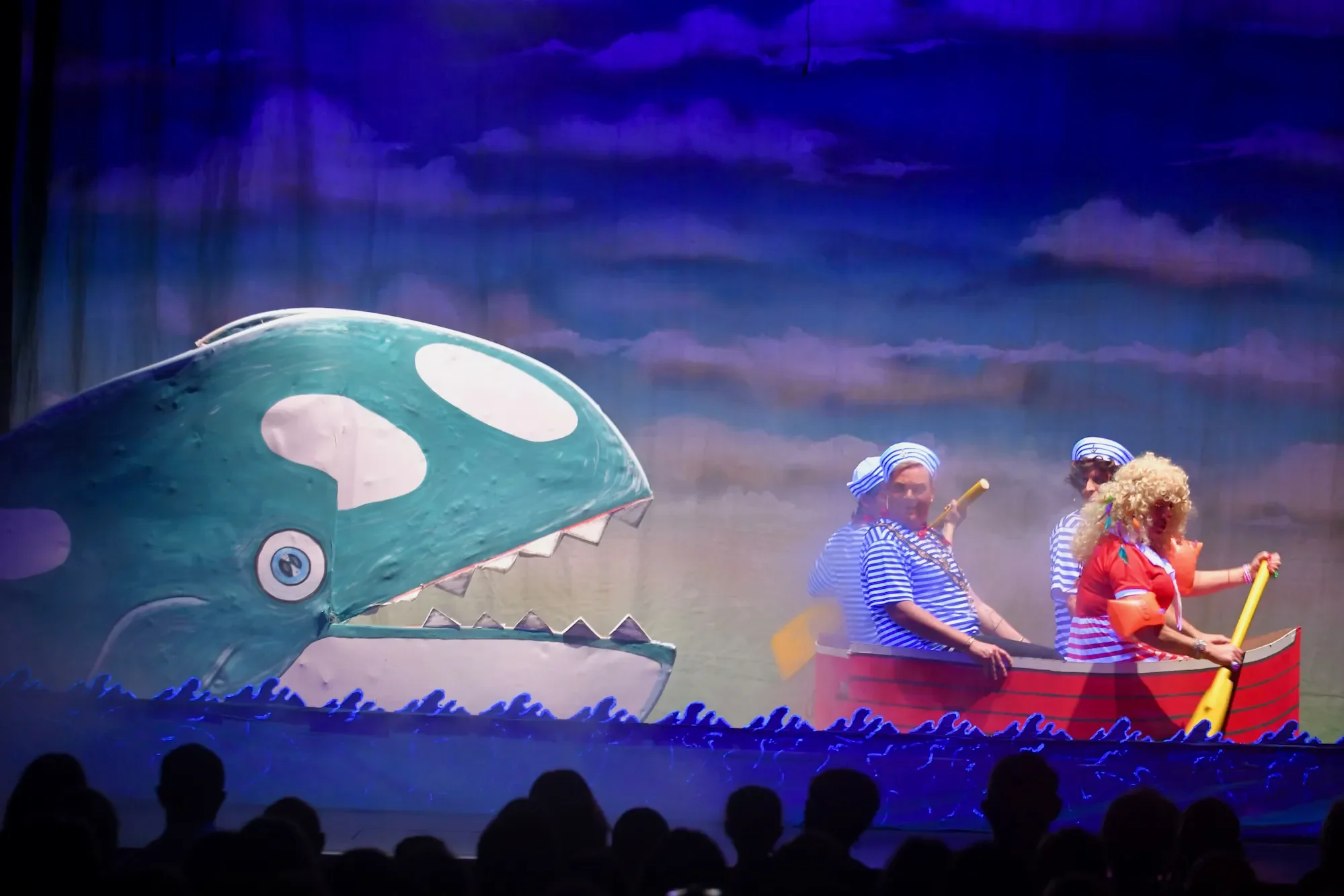
With 10 principal characters and nine supporting roles, more named supporting work than anything else we publish, plus a flexible Ensemble of Townsfolk, Circus Acts, Fish and Sea-Monsters, this sits among our Medium Cast Scripts. It also covers more physical ground than almost any other title in the catalogue, a workshop, a schoolroom, a circus, a cliff-top, a boat and the inside of a whale, so it rewards a group with the appetite for varied staging as much as a large ensemble. Six settings is a lot of staging to plan for, so if that feels a lot, you can browse all our Pantomime script titles for the complete catalogue.
As Churt Amateur Dramatics put it after performing the script, 'the characters were fabulous with lots of witty puns and quips.'
If that sounds like your company, request a free Perusal Script or visit the Pinocchio script page for the full synopsis and details. The Performance Licences page has the booking detail when you get there, and our home page covers everything else.