
Best Pantomime Scripts for Large Casts
The best pantomime scripts for large casts fall into two groups, and knowing which one you are looking at is the whole decision. A director with a large company can already see that a script has enough parts. What they want to know is whether the show will feel right with 35 people on stage, or whether two thirds of the ensemble will spend the run standing at the back looking decorative.
Settle that before you choose. Some pantomime scripts for large casts are built so that a big ensemble is structurally necessary: the setting demands it, the scenes lose their energy without crowd, and more performers make the show feel more like itself. Others scale up beautifully without needing to, so a large ensemble adds spectacle and gives more people something to do, but the script holds its shape at any size. Both are worth having. Below is which is which, with the principal count for every title so you can size it against your own company.
Scripts that need the numbers
These four are written for larger companies. They can be staged without one, but they work best where the ensemble is generous enough that no group is siloed into two scenes and a walk-on.
| Script Title | Principal Characters | Why It Needs a Big Ensemble |
|---|---|---|
| Robin Hood | 15 | Four distinct ensemble factions: Outlaws, Girl Guides, Sheriff's guards, townsfolk |
| Peter Pan | 14 | Three ensemble worlds: pirates, Lost Boys, mermaids |
| Snow White | 15 | Seven individually characterised dwarfs, plus a full ensemble |
| Alice in Wonderland | 14 | The Queen of Hearts' court needs a crowd to read as a kingdom |
Robin Hood: 15 principals and an archery competition that’s right on target
Robin Hood is the most ensemble-hungry script we publish, by design. Sherwood is full of people, and the Outlaws, Little John, Big John, Medium John and Not John, are named characters with personalities of their own, not crowd.
What sets it apart from the other large-cast titles is the number of distinct factions. The Outlaws, the Girl Guides under Brown Owl and Snowy Owl, the Sheriff's guards and the Nottingham townsfolk each have their own costume identity and their own reason to be on stage. Four groups means four separate briefing conversations with your ensemble, which tends to produce more purposeful performers than one undifferentiated crowd.
Dame Wilma Scarlet is an outlaw and the regional coordinator for the Sherwood Forest Girl Guides, which is a Dame job description with no precedent elsewhere in our catalogue. The Sheriff comes with Bluff and Blunder, two sidekicks of magnificent uselessness. With 15 principal characters, four supporting roles and a full ensemble, Robin Hood is spectacular. With six people and good intentions, it is a different sort of evening.
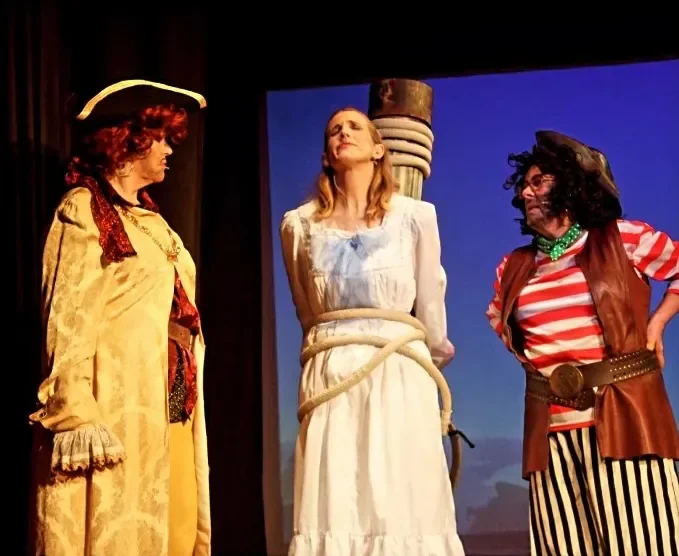
Peter Pan: 14 principals, three ensemble worlds, and a fairy with a body double
Peter Pan makes a similar demand in a different shape. There are three distinct ensemble pools: pirates, Lost Boys and mermaids. Each has its own costume identity, its own songs and its own staging logic, and the show loses something real if any of the three is thinly populated.
You have room to manoeuvre. Named Lost Boys can be merged, and Mr and Mrs Darling can be doubled by the actors playing pirates or Lost Boys later. If you run a youth group with a lot of children to place, this is one to look at seriously, since Lost Boys and mermaids give younger performers a clear character identity inside an ensemble. There is also Tinker Bill, Tinker Bell's body double, whose cameo is brief and earns one of the biggest laughs in the show.
Before you fall for it, bear in mind that UK productions of Peter Pan need an additional licence from Concord Theatricals on behalf of Great Ormond Street Hospital, alongside your NLP Performance Licence. Apply early. The Peter Pan script page has the detail.
Snow White: 15 principals, including seven dwarfs and a deeply reflective mirror
Snow White has the largest principal roster we publish at 15, seven of whom are the bearded brothers. Lucky, Dizzy, Jolly, Skippy, Cosy, Snoozy and Clappy each have a personality of their own and are not interchangeable. Clappy is written as a non-speaking role, which makes him a good fit for a younger or less experienced performer who still wants a proper character.
Those seven, plus Dame Babs, Queen Devilia, Snow White, the Prince, Simon, Sally, the Narrator and the Magic Mirror, account for the full principal list. Devilia is a full-blooded villain, vain, imperious and entirely convinced she deserves better. The Prince spends most of the show disguised as a delivery man, which gives the romantic lead a comic way in before he is revealed. Simon and Sally, Dame Babs's son and daughter, are both gloriously dim, so the comedy runs as a family affair from the first scene. The ensemble of townsfolk, deliverymen and ghosts expands naturally behind them, and the UV ghost sequence in the forest is one of the more striking set pieces in the catalogue.
Alice in Wonderland: 14 principals, and a court that needs a full court
Alice in Wonderland has 14 principal characters, five supporting roles and a setting that actively requires a crowd. The Queen of Hearts needs subjects: the Playing Card Guard and Wonderland's stranger citizens are what make her a tyrant presiding over a kingdom rather than a villain with a handful of friends. For sheer horribleness she is in the same league as Devilia in Snow White.
The cast spans an unusually wide range of playing styles. The Queen is a comedy villain with the house in her pocket from her entrance. Tweedledum and Tweedledee are her accidental henchmen, a double act built on the contrariwise mechanic. The Cheshire Cat opens and closes scenes in rhyming couplets and needs precise timing and real confidence with language. The Jabberwocky is written so it can be played by a child in a dragon costume, which makes it a memorable, self-contained part for a younger performer.
Duchess Battenberg, our Dame, is the Royal Baker, and would not look out of place in Hansel and Gretel. With the Tea Party carrying Act One and the Queen's court filling Act Two, your ensemble has two entirely different worlds to inhabit and to dress.
Scripts that scale up brilliantly
All our panto scripts flex. These three do it especially well, giving the ensemble real stage time without loading everything onto the principals. Two of them sit in the medium cast band on principal count and still fill a big stage once the ensemble is in.
| Script Title | Principal Characters | Why It Scales |
|---|---|---|
| Goldilocks and the Three Bears | 13 | Circus setting absorbs a large ensemble naturally |
| Rapunzel | 15 | Salon scene, plus four named royals across two kingdoms |
| The Little Mermaid | 12 | Two distinct worlds, underwater and surface, each with its own ensemble |
Goldilocks and the Three Bears: 13 principals, and a circus that gets better with more in it
Goldilocks and the Three Bears has 13 principal characters and three supporting roles, and its setting, a circus, does the work for you. The more performers you have as acrobats, clowns and trapeze artists, the more the big top earns its name. This is a show where a large ensemble is not compensating for anything. A company of 40 with 30 in the circus ensemble is exactly what the script has in mind.
Dame Bernie Barnum owns and runs the circus, so the comedy is built into the premise rather than bolted on. Madam Meanie, the rival owner, is a villain with a clear commercial motive. Daddy Bear, Mummy Bear and Baby Bear are individually characterised and bring a completely different energy in from the circus world. Charlie and Cooper, the identical twin clowns, need identical costumes with different coloured wigs. That is a design decision rather than a casting problem, but plan it early. Psychic Cheryl and the other two supporting roles flex easily into or out of the ensemble depending on your numbers.
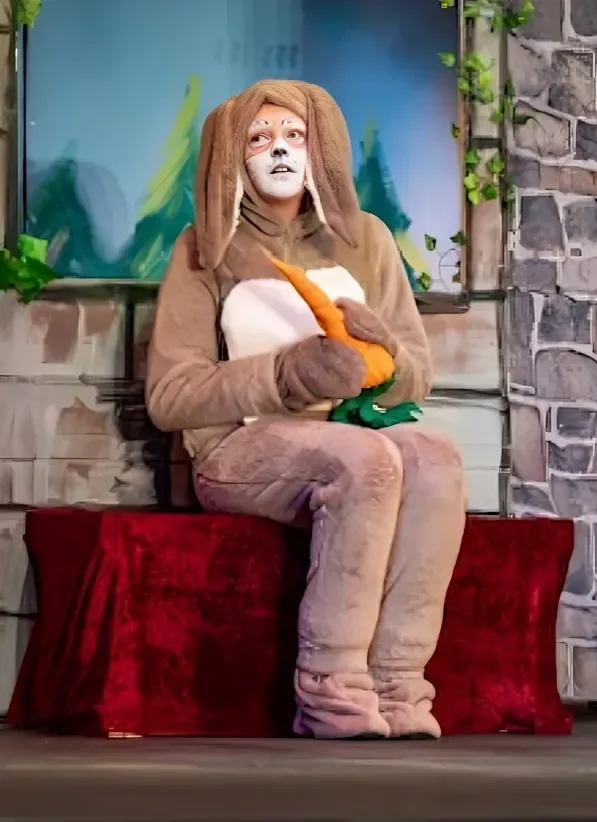
Rapunzel: 15 principals, and more haircuts than you can shake a comb at
Rapunzel has 15 principal characters, four supporting roles, a salon scene that needs an ensemble to make sense, and two sets of royal parents: King Reginald and Queen Marjory of Tangle-land, King Otto and Queen Agnes of Quiffendale. Four named royals is four substantial parts carrying real story weight without driving the central plot.
Dame Betty Beehive is a flamboyant hairdresser with no discernible skill, which generates most of the salon comedy. Her son Silly Billy carries the comic strand alongside her. Gothel, obsessed with eternal youth, arrives with Drip and Dribble, so the villain faction gets its own double act. Sidney, Gothel's reluctant son, adds a moral dimension to the threat rather than more comic menace. Rascal the rabbit, Rapunzel's oversized talking pet, is played by a person in a rabbit costume and is a good role for a younger performer. The ensemble covers townsfolk, salon customers, guards and ghosts, so four costume contexts across the evening if you want your ensemble to feel like they are playing several things rather than one crowd.
The Little Mermaid: 12 principals, and two very different worlds to fill
The Little Mermaid sits in the medium cast band at 12 principal characters, and it is here because of what happens when you scale it. There are two completely distinct performing worlds: an underwater kingdom, and a surface world of ships, palaces and shorelines. That split gives your ensemble two costume identities across one show. Mermaids, sea creatures and jellyfish below; sailors, citizens and palace guards above, played by the same people in different costumes.
The five supporting roles include Ariel's four sisters, Persil, Daz, Lenor and Own Brand, four named roles with their own stage time and a good fit for performers who want more than ensemble without carrying a storyline. Slip and Slap, the sea-witch Octavia's hapless henchmen, are a physical comedy double act that rewards casting as a contrasting pair. And there is Lobster Theodore, Queen Marina's right-hand crustacean, possibly the most pompous shellfish this side of the Atlantic. On paper this is a medium cast script. On stage, with both worlds properly populated, it is one of the most naturally spectacular shows we publish.
The ensemble question the scripts can't answer for you
All of these work with a large company. What none of them can tell you is where the line falls between principal characters and everyone else, because that depends entirely on your group.
Some directors with a company of 35 have 15 committed leads and 20 happy ensemble performers. Others have 35 people who all want a named role. Those are different problems with different answers. The principal counts above are the number of distinct speaking characters written into each script. They are not a ceiling on how many people can feel involved.
If your situation is closer to "lots of people who want substantive parts" than "lots of people who want the stage to look full", our Scripts for Medium Casts sit at 10 to 13 principals and tend to give more of the cast more to do at named-character level. If your company is compact, our Small Cast Scripts run to nine principals or fewer. Everything we publish is on the All Scripts page, and our home page is the quickest route into the rest of the site.
Request a free Perusal Script for any title above and we will get it over to you promptly, with no obligation. When you are ready to book, our Performance Licences page covers the rest.