
Jack and the Beanstalk is older than the English language, which isn’t a claim I can make about anything else in the catalogue. I’ll get to the pantomime in a minute, but the story underneath it goes back a lot further than the beanstalk itself does.
Older Than the Language Split
A 2016 study traced the tale type Jack and the Beanstalk belongs to, ‘the boy who steals an ogre’s treasure’ in the academic classification, back roughly 5,000 years, to around the time Western and Eastern Indo-European languages split from each other. The researchers built a family tree of folk tales the way biologists build one for species, treating each language’s version of the story as a descendant and working backwards to a common ancestor, using how a story’s building blocks recur and vary across languages to estimate how long ago the pattern must have first appeared. That’s one study’s method rather than a measurement, but it puts the underlying pattern, a boy, a giant, a theft, at the Bronze Age rather than the Victorian stage.
The same study gave Beauty and the Beast no age at all, just a mention as another widely travelled tale, so I won’t pretend there’s a matching number for that one too.
Jack Spriggins and a Giant Called Gogmagog
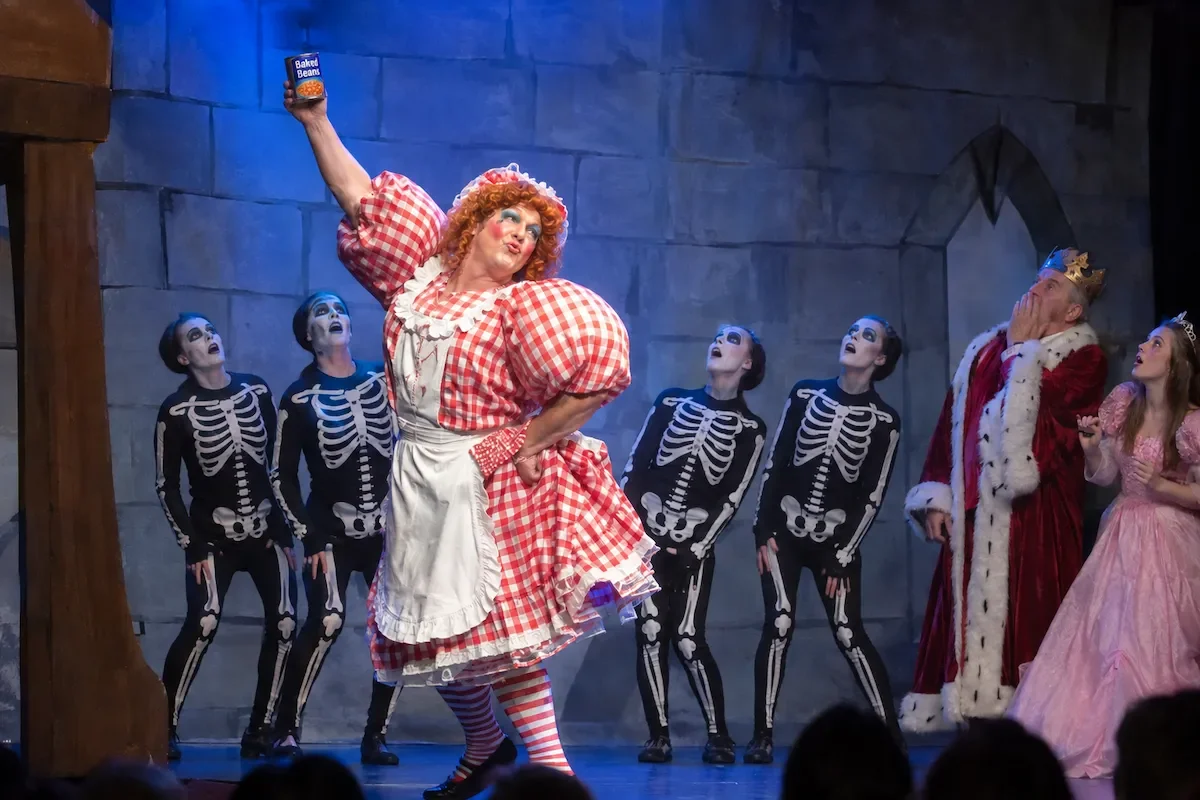
The earliest printed English version is The Story of Jack Spriggins and the Enchanted Bean, in the 1734 edition of a chapbook called Round About Our Coal-Fire. Jack lives with his grandmother rather than his mother in this one, and the giant has a name, Gogmagog, that nobody uses any more.
The version everyone actually knows comes from Benjamin Tabart in 1807. Tabart gave Jack a widowed mother, a cow traded for beans, and something the earlier chapbook didn’t bother with: a reason. A fairy tells Jack that the giant had robbed and murdered his father, which turns the theft at the top of the beanstalk into revenge rather than burglary, a very Victorian piece of tidying-up for a story he was aiming at children rather than a pub audience. Joseph Jacobs softened that in 1890, in English Fairy Tales, dropping the fairy’s speech but keeping a lighter version of the same idea, a giant with a known habit of eating stolen oxen and children. Jacobs is generally reckoned closer to how the story was actually told before anyone bothered writing it down at all.
Two Jacks, One Borrowed Giant
Most pantomime versions call the giant Blunderbore, which isn’t this story’s name for him at all. It’s borrowed from an entirely different tale, Jack the Giant Killer, where a different Jack strangles a giant of that name. I’ve gone into where Blunderbore actually comes from in Who Is Dandini?, so I won’t repeat it here. What’s worth knowing in this post is simpler: two unrelated stories, sharing only a hero’s first name and a taste for climbing and giant-killing, have spent centuries quietly lending each other’s furniture. That’s presumably how our own Jack and the Beanstalk ended up with a Blunderbore too, despite this story’s own giant traditionally having no name worth remembering.
The two tales also share a catchphrase, fee-fi-fo-fum, and that one’s older than both of them put together. Shakespeare has Edgar say a version of it in King Lear, written around 1605, over a century before either Jack story reached print, and even then it was already an old saying nobody could trace. The giant just inherited a line that was doing the rounds before he existed.
Onto the Pantomime Stage
Exactly when this became a pantomime is less certain than I’d like, and I’d rather say so than invent a tidy date. A Drury Lane production from 1859, billed with the full Victorian flourish as Jack and the Beanstalk; or, Harlequin Leap-Year, and the Merry Pranks of the Good Little People, is well documented, giant and beanstalk both present. A separate claim puts the first version as late as 1918, at the same theatre, which doesn’t square with 1859 at all, so I’m not using it. Somewhere in the 1850s, once fairy tales had properly displaced the classical subjects everywhere, is as precise as the record allows.
Dan Leno, already covered properly in the history of pantomime, played the Dame in this story twice at the Surrey Theatre in 1886 and at Drury Lane in 1889, over a decade before anyone had thought to write him a Mother Goose at all.
What’s Actually New
Almost everything about our own version is invention on top of very old bones. Jack has a brother in ours, Simon Trot, doing the Simple Simon job pantomime tradition expects of him, which is one more person than Tabart or Jacobs ever gave Jack to work with; their Jack is an only child in every version above. Dame Trot runs a dairy rather than anything either writer gave her, Fairy Haricot is a joke nobody in 1734 would have understood, and Pat the Cow is a two-person pantomime costume with her own running gags, several steps up from Tabart’s cow, who’s sold at market in one sentence and never mentioned again. The beanstalk itself is the one thing every production has to solve for itself, since nobody in five thousand years of telling this story ever had to make one grow on a stage eight times a week.
If you’d like to read our Jack and the Beanstalk script, ask for a free Perusal Script and I’ll send it to your inbox. If you’re interested in other titles, you can browse our pantomime script catalogue. Elsewhere, our home page and blog are worth checking out too.