
The Little Mermaid Pantomime Characters: A Complete Guide
Under the C: Every Character You’ll Be Casting
Our Little Mermaid pantomime characters are built to sidestep the Disney cast list, and the script says so out loud in the Prologue. What helps before casting is knowing who carries the comedy, who carries the plot, and how a large roster of named parts breaks down. Here that means Dame Beluga running most of the audience comedy through her singing-lesson obsession, Octavia scheming with two Marvel-obsessed henchmen, and four sisters named after washing-powder brands.
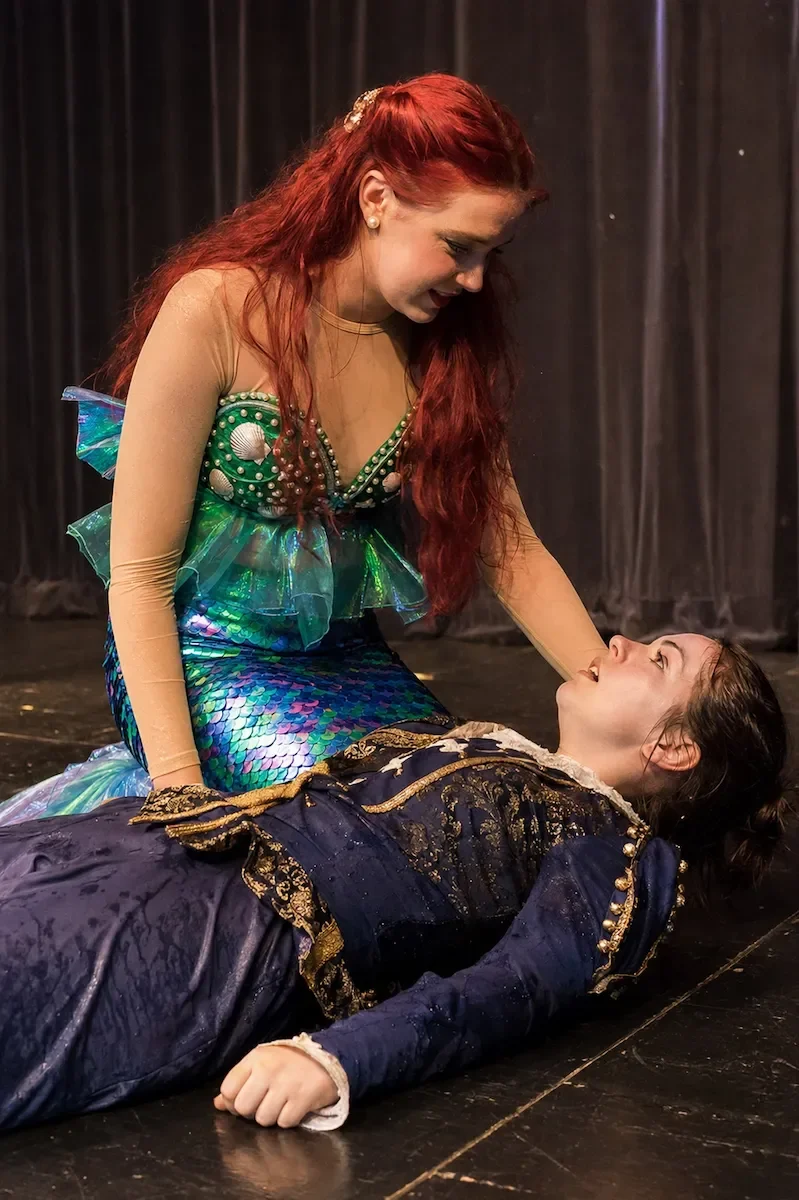
Ariel and Prince Evan
Ariel is the title heroine, and the script is upfront about the choice it’s making with her: the opening Prologue has the Spirit of the Sea telling the audience directly that this is ‘a kingdom of wonders, but it’s not Disney... or we might get in trouble with the copyright-ists.’ That self-aware distance runs through the whole script rather than just the opening gag: Octavia is Marina’s sister rather than a separate sea-witch, and the voice-for-legs bargain plays out very differently, with the voice passing comically between several other characters before Ariel gets it back herself, rather than being a straightforward theft-and-recovery plot.
Prince Evan gets a proper character arc alongside her rather than functioning as a prize to be won: he’s the one who notices something’s wrong when Octavia claims credit for his rescue, and it’s his hesitation at the altar, not a last-minute rescue, that actually stops the wrong wedding. Their courtship also gets a well-built silent stretch: once Ariel loses her voice, an entire scene plays out using a stack of hand-lettered cue cards, a homage to the film Love Actually, which gives a voiceless heroine a proper romantic beat rather than sidelining her until she can speak again.
Dame Beluga
The Little Mermaid is a modern addition to panto with no fixed Dame convention to follow or collide with, which means we’ve been free to invent Dame Beluga as the Royal Singing Teacher of the Seven Seas. Giving the Dame an occupation that generates the comedy rather than just the costume is a pattern that runs right through the catalogue, and Beluga sits alongside Dame Betty Beehive’s salon in Rapunzel and Dame Kitty Kipling’s bakery in Hansel and Gretel.
Her best device is the audience call and response built around singing technique itself: ‘Where do we start?’ met with ‘From the top!’, which gets reused right through to the finale rather than staying confined to one scene. She also gets one of the script’s cleverer plot mechanics handed to her by accident: when Ariel’s voice is released from its shell, it passes between characters as a spotlight moves, and it’s Dame Beluga who ends up holding it first, speaking in a voice that isn’t hers.
Scampi
Scampi is Ariel’s friend rather than the Dame’s son, which is a departure from the comic-son-of-the-Dame shape used elsewhere in the catalogue (Silly Billy in Rapunzel, Hugh in Peter Pan, Greg Kipling in Hansel and Gretel). Giving the comic a direct friendship bond with the heroine instead changes what the role can do: Scampi is present for Ariel’s biggest decisions rather than orbiting the Dame’s plotline, and his nervous, ‘I’ve got a bad feeling about this’ refrain (reused when the voice briefly lands on him mid-scene) makes him an audience surrogate for the risk Ariel’s taking, not just comic relief standing apart from the plot.
Octavia the Sea Witch
Octavia is Queen Marina’s sister rather than a stand-alone sea-witch, a deliberate structural choice that gives her scheme a personal, family-grudge motive (resentment over the trident and the throne) rather than generic villainy. She gets a sharply self-aware villain monologue, admitting outright to the audience that she’s borrowing, not stealing, Ariel’s voice, ‘permanently’, and her longing to reach a vocal high C gives her vanity a specific, performable detail rather than a vague claim to beauty.
Slip and Slap
Octavia’s henchmen fit the double-act device this catalogue leans on repeatedly, in the same mould as Bluff and Blunder in Robin Hood and Drip and Dribble in Rapunzel. What’s distinctive here is the specific obsession driving their comedy: Slip and Slap are devoted Marvel fans who filter every plan through superhero references, right down to home-made Captain America and Iron Man props, and it pays off properly at the very end with a joke the script has been building the whole show (you’ll have to read the script to see what it is though!) Casting two performers who can commit fully to earnest comic-book enthusiasm gets more out of the part than treating it as generic henchman bumbling.
Queen Marina and Lobster Theodore
Marina is a warmer, more sympathetic monarch than the ‘overprotective mother’ panto shorthand suggests, with a specific, disclosed reason for her fear of the surface (her own parents were lost to fishing nets) that gives her conflict with Ariel real weight rather than blanket strictness. Theodore, her lobster right-hand man, runs an escalating running gag around his own overlong title (Her Majesty’s Most Loyal Hermit, Guarder of the Oysters, Keeper of the Pearls, Defender of the Reef, and Generally Snappy Dresser), which the Ensemble eventually finish for him in unison, a nice example of a bit that gets funnier by being interrupted rather than repeated straight each time.
King Godfrey and Willis
Godfrey is a comic monarch built almost entirely around one device: everything he does is justified as his ‘royal prerogative’, from alphabetising life jackets to marrying off his son, and it’s versatile enough to carry gags from the opening ship scene right through to the wedding. Willis, his son’s confidant, plays a similar structural role to Dandini in Cinderella: a prince’s right-hand man who helps move the plot along and gets his own share of the wordplay, rather than Dandini’s ball-scene logistics.
The Spirit of the Sea
The Spirit narrates in rhyming couplets and nudges the plot at the right moments, in the mould of the catalogue’s other guide figures: Fairy Stardust in Rapunzel, Fairy Sparkles in Cinderella and Fairy Haricot in Jack and the Beanstalk all play the same comic-support role rather than a solemn, straight fairy godmother.
Persil, Lenor, Daz, Own Brand and Annette
Ariel’s four older sisters are named entirely after washing-powder and fabric-softener brands, and the joke is played consistently rather than as a one-off: their capture scene runs on laundry puns throughout (‘I’ll take you for a spin cycle’, ‘ready to tumble’). Own Brand gets the nicest character beat of the four, staying free of the villains’ net through her own quick thinking and getting proper credit for it from Marina afterwards, a good pay-off for a character introduced as the ‘cheaper’ one the others slightly look down on.
Annette, who turns up for a single scene to hand Slip and Slap a fishing net and break the fourth wall directly to the audience, is a fun one-scene cameo rather than a role to build a casting decision around; a good pick for someone who wants a small, self-contained moment rather than a full part. Worth knowing for your own planning: Sophie, Bella and Penelope, three princesses lined up as marriage prospects for Evan, are named twice in the script but never actually appear.
Casting The Little Mermaid Pantomime Characters: Who It Suits
With 12 principal characters and five supporting roles, plus a flexible Ensemble of mermaids, sailors, courtiers and jellyfish, this sits among our pantomime scripts for medium casts. If you’re considering it against other titles, our full range of pantomime scripts is worth a browse too.
If this cast list sounds like a fit for your group, request a free Perusal Script for The Little Mermaid or visit the Little Mermaid script page for the full synopsis and details. If you’re further along and already thinking about booking, our Performance Licences page has everything you need, and our FAQs or Homepage can point you to anything else.