
Performing to a Pantomime Audience
One of the things that makes pantomime different from almost every other form of theatre is the audience. They're not there to watch quietly and applaud politely at the end. They're there to boo the villain, cheer the hero, shout warnings at the principal, and collectively shout "Oh no they didn't!" in response to a prompt they've often known since childhood. The audience is a participant in the show, not a spectator of it, and performing with that audience, rather than at them, is one of the core skills of pantomime. Much of this will be obvious when reading through your chosen panto script, as well as throughout rehearsals, but I’ve always found a refresher brings back one or two bits that can give an extra boost.
Talk to the Front, Perform for the Back
The best engagement in any panto comes from the rows closest to the stage. There's an intimacy there that you don't get with the rows further back, you can see individual faces, register reactions, build a direct connection with specific audience members. Playing to those front rows is where the best comedy business lives. (Its also the best place for your Dame to pick a victim… I mean willing audience member, to flirt with.)
But playing only to the front is a mistake. The back third of the house is still paying for their seats, and they need to hear, see, and feel included. The principle I'd suggest is to engage through eye contact and direct address with the front, but project voice and physical performance toward the back. If you can be heard clearly in the last row, you'll be crystal clear in the front three.
This applies to singing and dancing as much as to dialogue. Singing forwards, keeping the face open and the voice directed toward the house rather than toward other performers, is a discipline that makes an immediate, audible difference. The same applies to movement. Dancing with full energy and a visible face reads very differently from the same choreography performed with the eyes on the floor.
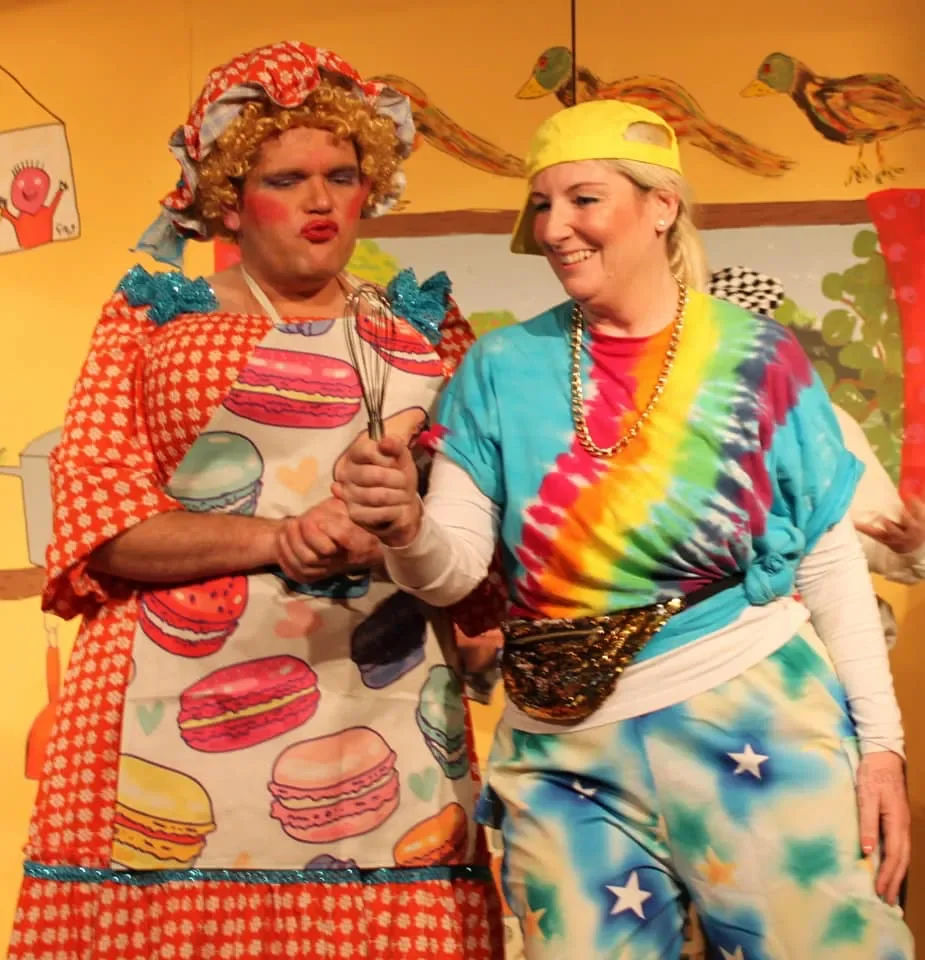
Overacting Is Its Own Problem
There's a common assumption that pantomime requires constant broad performance: big gestures, exaggerated expressions, non-stop energy. Some of that is true, pantomime is not a kitchen-sink drama, and the form does reward a bigger style than some other genres. But there's a ceiling, and going past it makes things less funny rather than more.
An action or a line should be given the emphasis it deserves, not the maximum emphasis it's physically possible to deliver. The size of your performance should match the size of your auditorium and the size of the moment. A small, quick reaction shot in a comic scene can get a bigger laugh than a full-body collapse. Save the big moments for when they'll actually land as big moments, if everything is performed at maximum, nothing feels special.
Be aware too that the audience can see you even when you're not speaking. If you're at the back of the stage during someone else's scene, you're still onstage. Stay present, stay in the scene, and stay in character. A performer visibly waiting for their next line, or watching the wings to see who's coming on, is a distraction that costs the scene more than most performers realise.
Audience Participation Takes Planning
The participation elements of pantomime, "He's behind you," booing the villain, the call-and-response with the Dame, the ghost gag, the song sheet, are among the best parts of the form, and they work best when they're carefully thought through rather than improvised on the night.
The structure needs to be clear and the cues need to be clean. If the audience is supposed to shout something back, they need a clear invitation to do so, and if that invitation isn't readable, they'll hesitate, or respond half-heartedly, and the moment will flatten. The best audience participation routines build. They establish what's expected, they get the audience doing it, and then they find ways to play with the dynamic they've created.
What makes audience participation work is that the audience feels included, not just instructed to comply. There's a difference between prompting a room full of people to respond on cue and actually bringing them into the show. The performers who are best at this treat the participation moments as conversations. They listen as well as speak, they respond to what the audience actually does rather than what they're supposed to do, and they find the fun in the unpredictability rather than being thrown by it.
Have Fun
This is the one piece of advice that's hardest to give because it sounds too simple. Enjoy yourself. Not in a performative way, not as a technique, actually enjoy what you're doing on that stage. Fun is legible. Audiences can see when a cast is having a good time, and it's one of the most reliable ways to bring a room with you.
Adrenaline on opening night is an asset, not a problem. The energy in the building when the curtain goes up is infectious, and audiences who feel that energy in the first five minutes are much easier to hold for the next two hours. Knock the first scene out of the park and they're yours.
If you'd like to see how our scripts handle the audience participation elements you can request a free Perusal Script and see for yourself. We've got a full range of scripts to suit different company sizes and experience levels.
If you’ve got questions, please visit our Homepage, which has plenty of helpful links, check out our Frequently Asked Questions, or Contact Us.