
Is Your Pantomime Running Too Long?
How to spot the drag before your audience does.
A pantomime running too long is one of the most common problems we hear about from groups partway through rehearsals. It's rarely the script's fault on its own, and it's rarely fixed by cutting jokes either. Most overruns come down to a handful of specific, fixable habits.
The two-hour benchmark
As a rough guide, a well-paced pantomime runs to just over two hours including the interval. A bigger cast or a more elaborate production can sometimes run a little longer, but if your dress rehearsal is creeping past two and a half hours, something is padding the show rather than earning its place in it.
Songs, and the difference a live band makes
From my experience, songs are one of the most common reasons a show runs too long, either they're too long individually, or there are simply too many of them. We'd recommend your songs run to around three minutes, or less if you can, with a short intro wherever the arrangement allows, long enough to make an impact but short enough not to stall the story around it. A song run for an extra verse because the cast are enjoying it, or reprised because it went down well in rehearsal, is often the first thing an audience notices dragging. A brilliant short number is better than an average long one. As the phrase goes: always leave them wanting more.
If you're working with a live band rather than a backing track, you've got more room to play with the song's structure, and can even vamp an extra few bars if the cast aren't quite ready. The other advantage of a live band is that you can alter songs in ways you simply can't with a backing track.
Scene changes, and what Front of Tabs is actually for
Scene changes eat more time than you think, but our scripts are built to solve most of this for you already. Full set changes are designed to happen behind closed curtains while a Front of Tabs scene keeps the story moving and the stage occupied. If a scene change is dragging, the first thing worth checking is whether the Front of Tabs scene ahead of it is being used as intended, since that's exactly the time it's there to cover. Most full-stage scenes are also written to be staged simply on purpose, so if a change is still overrunning the Front of Tabs scene in front of it, it's usually because more has been added to the set than the script actually calls for.
Pace, Pace, Pace
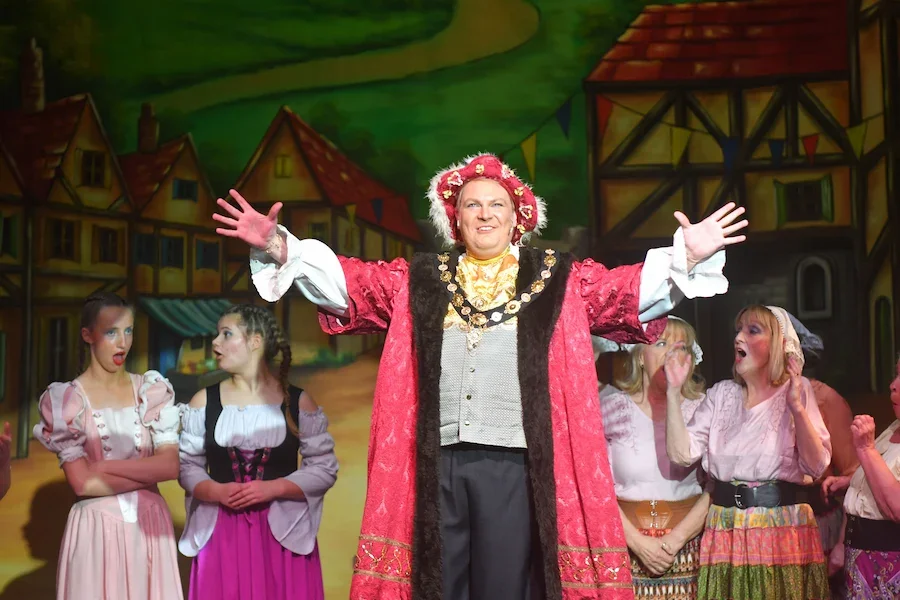
If your show is still overrunning after all that, the next thing to look at is pace, not speed. Pace is about momentum, not about actors talking quickly, and it's usually won or lost in the small gaps between moments rather than within them.
The stage should never sit empty. When one group of characters is leaving and another is due on, bring them onstage as the first group moves off. It doesn't matter that it isn't strictly realistic, what matters is that the stage stays alive and the story keeps moving rather than pausing to let one group clear before the next group arrives. The same logic applies to individual entrances. Come on half a beat early, so you're already in position by the time your line lands, rather than still arriving as you're saying it. A slight overlap on cues, picking up your line a fraction before the other actor has quite finished theirs, does the same job in dialogue, keeping an exchange feeling alive rather than politely taking turns. Think about how real conversations happen. We naturally speak slightly over each other, and that's exactly the effect worth aiming for here.
None of this means rushing, however. The audience will keep up if you simply get on with the show, they don't need a pause to catch up, but a cast visibly trying to talk faster to save time usually loses clarity long before it gains any real minutes back. Pace is a directing and blocking problem, not a speaking-fast problem, so treat it as one.
Rehearse for diction, not just speed
None of this works if the audience can't understand what's being said. A handful of scenes in every script are written to move fast on purpose, and those are exactly the ones worth extra rehearsal time on clarity rather than speed. Sarah's menu-listing gag in Dick Whittington and Buttons and the Ugly Sisters' alliterative scene in Cinderella are two of the trickiest in the catalogue for this, rapid-fire lines that only land if every word is landing clearly, not just quickly. In Pinocchio, Dame Geppetto has a long monologue early in Act Two, where the whole point is that she summarises the first act at super speed. Run scenes like these on their own, slowly at first for diction, then build back up to full pace once every word is clean.
Audience participation routines that overstay their welcome
Audience participation is one of pantomime's oldest traditions and strengths, but it's built on a three-attempt structure for a reason: quiet, better, loudest. Your audience knows this, and will happily raise the volume upon instruction. A fourth or fifth go at the same catchphrase might feel generous in the moment, but a routine dragged out past its natural third beat starts to lose the audience rather than build them.
Balancing what you add and what you cut
The same logic about balance runs in both directions. If you're writing in a scene of your own, for a local reference, a topical joke, or simply because it works for your cast, decide what it's replacing before you add it rather than after, since a script that's been timed and paced as written will run long the moment something new goes in without anything else coming out. Our scripts are built with exactly this kind of flexibility in mind, so plan the swap rather than discovering the overrun in dress rehearsal week. If you're cutting rather than adding, resist reaching for the jokes first. Check whether each scene is actually doing a job, moving the plot, developing a character, or delivering a set-piece the audience is there to see, before deciding what goes. Don't forget that if you're looking to make these more substantial edits, you'll need to purchase the Editable Master Script alongside your Performance Licence.
If you're working with a bigger cast
Everything above matters even more once you're working with a bigger cast. A show like Rapunzel or Robin Hood, both among our larger-cast titles, has more principals to keep track of on stage at any one time, so the overlapping entrances and exits covered above are doing even more work to keep things moving. A smaller-cast show such as Hansel and Gretel naturally has fewer moving parts to manage, which is worth bearing in mind if you're working to a tight rehearsal schedule. Either way, the same discipline pays off, it's just that a bigger cast rewards it more.
If you'd like to see how one of our scripts paces across a full two acts before you commit, request a free Perusal Script or browse our pantomime script catalogue. Or start on our home page to get a feel for the whole catalogue first.