
Robin Hood Pantomime Characters: A Complete Guide
Robin Hood is the rare panto hero who turns up with nothing left to learn, so our Robin Hood pantomime characters have to supply the comedy and the jeopardy around him. That means an outlaw Dame who is secretly the most organised person in Sherwood, a Sheriff undone by his own mother and her sandwiches, and four Outlaws all named John. Here's the cast, and who tends to suit each part.
Robin Hood and Maid Marian
Robin arrives exactly as tradition demands, charming, generous and entirely unbothered by his own reputation. Their first meeting sets the whole relationship up in two lines: Robin introduces himself as 'Charming, dashing, generous…' and Marian finishes the sentence for him, '…Arrogant, reckless, in love with yourself.' His only defence is that 'I just happen to appreciate the view when I pass a mirror.' She's arrived in Nottingham incognito to escape exactly this kind of performance and gets it anyway, first from the court she left behind, then from Robin himself. Their scene in the woods, where insults slowly turn into something warmer, is the show's real hinge: by Act Two it's Marian's own speech about seeing 'behind all the bravado and self-adulation' that talks the Outlaws into the rescue.
Dame Wilma Scarlet
Robin Hood doesn't carry the same fixed Dame convention that Aladdin or Dick Whittington do, so Wilma Scarlet is our own invention rather than a name we inherited. We gave her a double job, Outlaw and 'regional coordinator for the Sherwood Forest Girl Guides', which does real work later: her Girl Guide contacts are what actually get Robin out of the dungeon. Her running joke, that she's more capable than anyone gives her credit for, sets up the audience's own call and response, where she says 'That doesn't look right' and the house answers 'See it, say it, sorted!' It pays off properly when the trolley of supplies she has been mocked for wheeling on turns out to hold exactly what a rescue needs.
The Sheriff of Nottingham
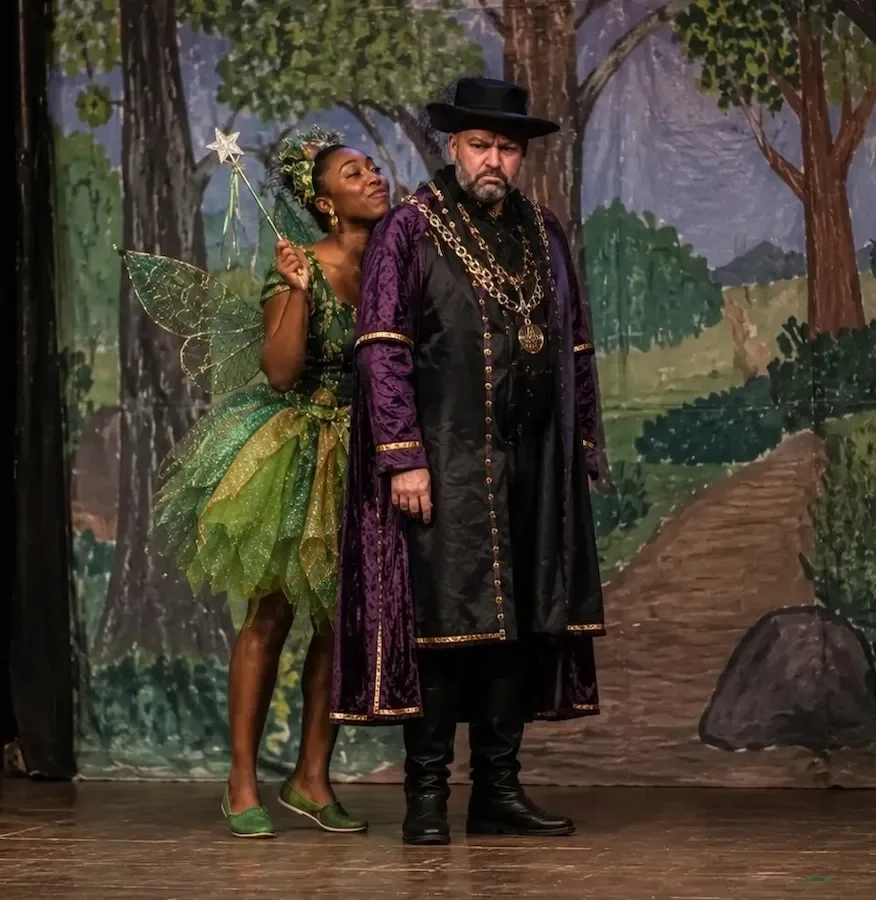
The Sheriff is one of the few fixed points in Robin Hood tradition, and we've kept him there while building his defeat around romantic humiliation rather than pure comeuppance. His fixation on Marian, his disastrous Love Potion scheme, which ends up dosing Wilma, Bluff and Blunder instead of its intended target, and his own mother turning up mid-villainy with sandwiches all chip away at his authority well before King Richard formally sentences him. A tyrant who still gets sent to his room by his mother is never quite as frightening as he thinks he is.
The Spirit of Sherwood
Our storytelling device, addressing the audience directly in rhyming couplets to keep the plot moving, and occasionally undercutting her own rhymes by making up brand new words: 'Are brimming with cheer and full of... Applaudience!' The Sheriff rolls his eyes while the audience applauds, which tells you how seriously the part takes itself. A rhyming guide figure who bridges scenes this way is a device we come back to across the catalogue in different forms, cheerful here rather than solemn.
Bluff and Blunder
The Sheriff's henchmen are a straightforward double act built on shared incompetence, from the bottomless tax bucket in Scene One to falling in love with Wilma via the wrong tray of tea.
Giving the villain a hapless pair rather than a single sidekick is a device we return to right across the catalogue. Grabbit and Runn chase Baron Hardup's debts in Cinderella, Slip and Slap serve Octavia in The Little Mermaid, and Drip and Dribble do Gothel's bidding in Rapunzel. Two performers give the comedy somewhere to bounce instead of landing on one. What sets Bluff and Blunder apart is the Act Two handcuff sequence, where their incompetence becomes the actual mechanism of Robin's escape instead of a source of jokes at the edges of the plot.
Alan-a-Dale and Eleanor Dale
Alan and Eleanor open the show as the audience's way in, welcoming everyone to Nottingham before Robin or Marian even appear. Alan's place in Robin's gang and Eleanor's fast friendship with Marian connect every other group in the show, Outlaws, townsfolk and royalty, without either of them needing a subplot of their own. Sibling pairs like this run through several of our scripts, Simon Trot backs up Jack in Jack and the Beanstalk, and Sally and Simon do the same for Dame Babs in Snow White.
Friar Tuck and the Four Johns
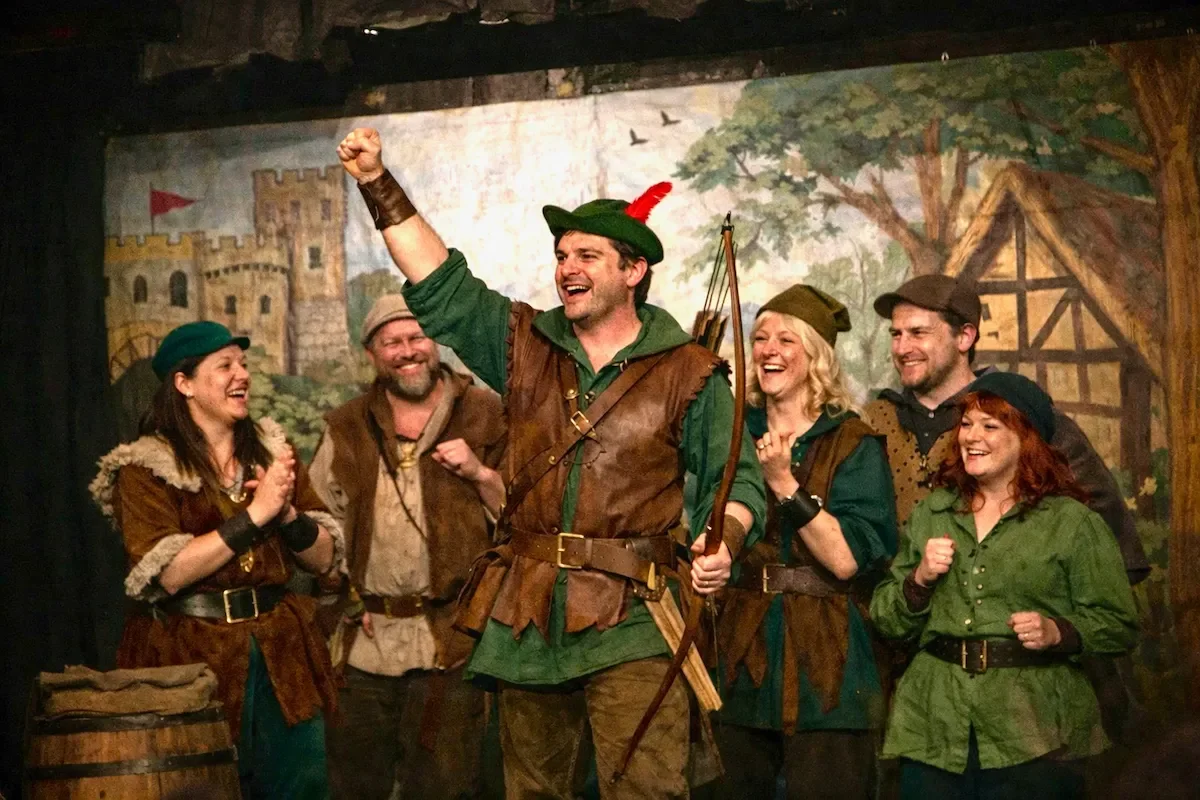
Friar Tuck and Little John are both part of the wider Robin Hood tradition, and we've kept them while building extra comedy around the edges of each. Tuck arrives with a new rolled-up poster in nearly every scene he's in, each one worse than the last, and his dry asides give him more presence than a purely functional messenger role usually gets; catching Marian with a dreamy look, he warns her 'that's how nuns start'. Little John, meanwhile, has grown into a comic quartet: Big John, Medium John, whose full name is 'Not-as-big-as-Big-John-but-bigger-than-Little-John John', and Not John, whose entire joke is that he isn't called John at all. They arrive as 'The Four Johns of the Apocalypse' on hobby horses, crash offstage almost immediately, and exit the plot just as fast, a lean, disposable gag that doesn't need much stage time to land.
Mum, Brown Owl and Snowy Owl
Mum undercuts the Sheriff's villainy every time she appears with a tray and a scolding, and her running gag, that a proper cup of tea fixes everything including a Love Potion, gives her more plot function than a comic parent usually gets. Brown Owl and Snowy Owl run the Girl Guides with the discipline the Outlaws entirely lack, and their kitchen-drawer motivational speech, in which you have to 'BUCKLE up' as Marian holds up a belt, 'get on BOARD' as Eleanor holds up a chopping board, and 'stick to your GUNS', is one of the script's best-built set pieces, turning ordinary props into the punchline one at a time.
Janet the Jailor and King Richard
Janet is a gentle subversion of the frail-old-lady stereotype. She has Robin in a headlock within seconds of meeting him, and her out-of-tune recorder becomes a genuine plot device rather than a one-off gag, summoning the Girl Guides to the rescue when it's played in anger. King Richard appears only in the closing scenes, but his arrival resolves the Sheriff's fate in one line and supplies the finale's last, very silly Love Potion mix-up of his own.
Casting the Robin Hood Pantomime Characters: Who It Suits
Between the Outlaws' camp and Nottingham Castle, this script has 15 principal characters and four supporting roles, plus a flexible Ensemble of Townsfolk, Outlaws, Girl Guides, Archers, Guards and Ghosts, which puts it among our Large Cast scripts. The full catalogue is on our All Scripts page if you're weighing up titles, and our home page links to the rest of the site.
If your company has grown faster than your last few scripts have, this is the one that will absorb everyone. Request a free Perusal Script, or visit the Robin Hood script page for the full synopsis and details. Our Performance Licences page covers the booking stage when you get there.