
Sleeping Beauty Pantomime Characters: A Complete Guide
Our Sleeping Beauty pantomime characters include a Dame who is also the Queen, which is the older of the two traditions and, we'd argue, the funnier one. Nobody expects the monarch to be the one wrestling a roll of wrapping paper. Around her sit an overprotective King, a herald with no working trumpet and a very good idea about what to do instead, and a Carabosse who ends the show cursed to be nice. Who to cast, and what each part needs, follows.
Princess Aurora and Prince Juan
Aurora spends most of Act One a prisoner of her father's anxiety rather than her own curse, locked in the castle until her twenty-first birthday and addressing the audience directly to fill them in on the years they've missed. She falls for Prince Juan within moments of meeting him, in the time-honoured panto tradition of falling in love roughly four lines after an introduction, and his loyalty is tested hard by a suspicious King before their true love's kiss finally breaks the curse. Their best-earned line is saved for the very last scene, when Aurora tells him 'you're better than that... You're my Juan true love!', a pun planted the moment he's introduced.
Before Juan arrives, Aurora is paraded past three comic suitor princes, Chris, Tim and the elderly, forgetful Peter, who are one-scene walk-ons rather than characters needing casting in their own right, so they don't get their own entries here. Our Author's Notes suggest adjusting their names and home towns to something local, in the same spirit as Cinderella's flexible Master of Ceremonies announcing local guests at the Royal Ball.
The King, Queenie and Gerald the Herald
King Roland, Queen Beatrice (Queenie to everyone) and Gerald the Herald share almost every scene between them, and it makes sense to cast and think of them as a unit.
Roland is the overprotective father the whole first act runs on. His response to Carabosse's curse is to ban spindles, needles, jazz, rubber and marching, an escalating punny list around the words band and banned, that gets funnier with each addition. Queenie is our Dame, true to the older Queen-as-Dame convention rather than the newer Nurse figure, and she gets a proper physical comedy set piece with a roll of wrapping paper that keeps rolling itself back up, plus an escalating handkerchief gag with the King and Gerald where each hankie handed over is larger than the last, ending with one the size of a bedsheet.
Gerald is our stand-in for the traditionally named Muddles, minus a working trumpet, which sets up the show's best audience participation device. He teaches the house that when he shouts 'It's the king!' everyone toots like a trumpet as loudly as they can, and the fanfare is theirs for the rest of the evening. He also gets a surprising near-miss romantic moment with Queenie during the Act Two sleepwalking scene, played entirely for laughs, and flag it in rehearsal so nobody is caught off guard by the stage direction.
Carabosse and Plum
Carabosse's name is a genuinely traditional one. Perrault left his uninvited fairy unnamed, and Carabosse arrived from a different French tale by way of the Tchaikovsky ballet, so unlike most of our Dames and villains, this is not our invention. What is distinctively ours is her ending. Instead of being banished or defeated, she's magically cursed to be nice by the three good fairies in the final scene, and spends the rest of it handing out unexpectedly generous gifts: a holiday, a new trumpet for Gerald, an early retirement for Plum. It's a redemption arc few other panto villains get.
Plum is her sidekick, and a solo hapless one rather than half of a double act, which is a departure from the henchman pairing we usually give our villains. He's closer to Bean, who serves Madam Meanie in Goldilocks and the Three Bears, than to Slip and Slap, who serve Octavia in The Little Mermaid. Carrying the comedy alone, he also ages a full hundred years alongside the sleeping curse, so the actor spends all of Act Two on a stick or a Zimmer frame, with a runner of fruit-themed malapropisms that need very little directing to land. His surname turns out to be Tomatoes, which Carabosse flatly refuses to believe until he offers his sister Cherry as proof.
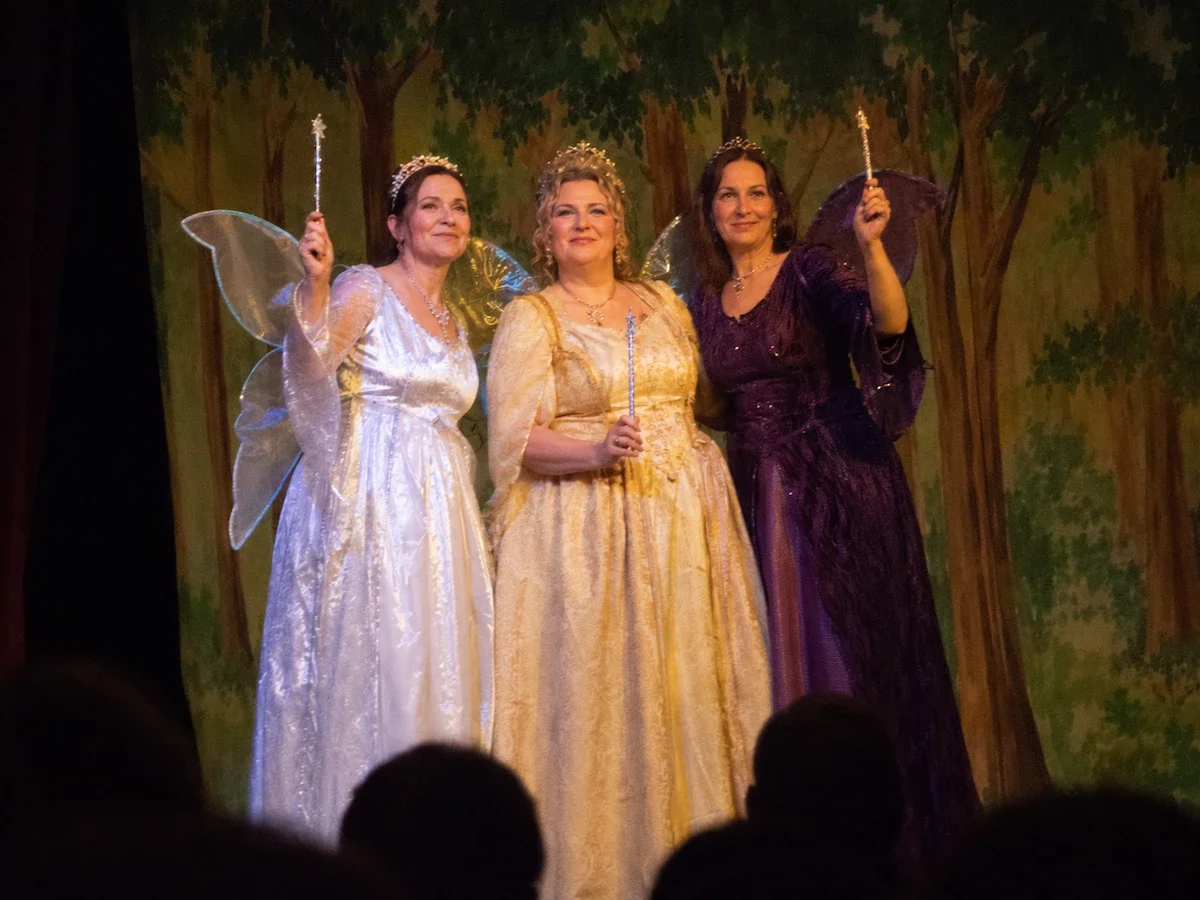
Fairy Silk, Fairy Cashmere and Fairy Velvet
Traditional tellings of Sleeping Beauty usually feature several good fairies bestowing gifts, rather than the single fairy-godmother figure more familiar from other fairy tales, so our trio sits comfortably within the wider convention, not against it. Silk, Cashmere and Velvet are differentiated by fabric-themed personality, not plot function. Gerald introduces Silk as 'soft, smooth and always looks gorgeous', Cashmere is smart and warm, and between them they narrate the scene transitions in rhyming verse throughout the show. That's a different shape from the single-fairy-helper pattern found elsewhere in our own catalogue, where Jack and the Beanstalk's Fairy Haricot works alone, so directors familiar with our other titles shouldn't assume the same casting shape applies here.
Casting the Sleeping Beauty Pantomime Characters: Who It Suits
At 10 principal characters and three supporting roles, Sleeping Beauty sits comfortably in our Medium Cast scripts, with plenty of scope to expand the Ensemble of townsfolk, fairies, extra princes and ghosts to suit a larger group. The rest of the catalogue is on our All Scripts page, and our home page links to everything else.
As the Border Telegraph put it, Sleeping Beauty was given ‘the full pantomime treatment: outrageous characters, slapstick comedy, and plenty of opportunities for the audience to join in.’
Gerald's fanfare only works if the house is properly taught it in Act One, so read that scene before you cast him. Request a free Perusal Script, or visit the Sleeping Beauty script page for the full synopsis and details. Our Performance Licences page has the booking side covered.