
Hansel and Gretel Pantomime Characters: A Complete Guide
The Hansel and Gretel pantomime characters in our version all live in Sugartown, where the Dame runs a bakery, the villain names her crimes after recipes, and the henchman goes vegan by the final scene. Below is every named part, what it is actually like on the page, and the sort of performer it tends to suit.
Hansel and Gretel
The title characters come fairly closely from the Brothers Grimm original: two children sent into the forest, a trail that fails, a house made of food, a witch with an oven. What our script does with them is give them comic timing instead of playing them straight as fairy tale victims. Hansel's bag of stones for leaving a trail earns some good gags, and it's Gretel who gets the script's sharpest moment. When Griselda tries to trick her into checking the oven, Gretel plays along and pushes the witch in herself, on her own initiative, without waiting to be rescued. That changes who you cast. The part needs someone who can hold a scene alone against the villain.
Both characters also have to sustain a sibling double act, bickering, finishing each other's sentences and being thoroughly petulant stepchildren, as well as carrying individual moments. Look for a pair with existing chemistry if you can.
Dame Kitty Kipling
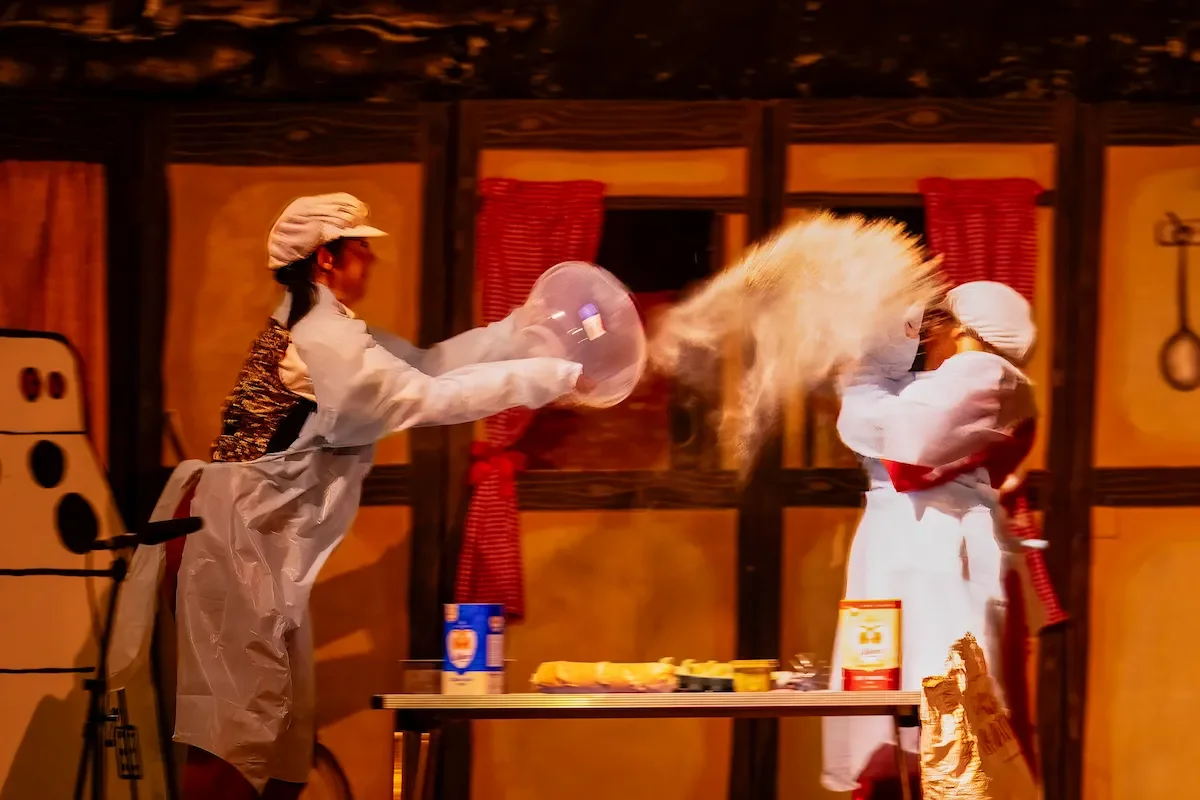
Hansel and Gretel sits outside the historic core of the pantomime repertoire in a way Cinderella and Snow White don't, and no traditional Dame name has attached itself to the story. That left us a free hand, and the result is Dame Kitty Kipling, Sugartown's baker, cake-maker and self-appointed biscuit connoisseur. She also makes a mean profiterole tower, which gives your props department something to think about.
The Ensemble spend most of Scene One trying to land a marketing slogan for her baking, exceedingly tasty, exceedingly delicious, exceedingly marvellous, and never quite managing it, which is the kind of running joke that rewards a Dame with sharp comic timing; costume alone will not carry it. Kipling also carries the show's audience participation device: whenever she feels herself losing control she calls out 'I'm gonna go!' and the audience shout 'Use your loaf!' back at her, a call and response that gets reused right through to the ghost chase in the forest. Her backstory has a proper pun buried in it too. Her ex-husband Rudyard left her to become an author and write The Jungle Book, which tells you the register the character lives in, and proves this script offers more than just the Bear Necessities.
Giving the Dame a trade is a pattern that runs across the catalogue, which matters if you're casting more than one of our scripts. Widow Twankey runs a laundrette in Aladdin, Sarah the Cook runs a restaurant in Dick Whittington. Kipling's bakery is the same idea in a different shopfront, so a Dame who has played one of those before will find this familiar territory.
Greg Kipling
Greg is Dame Kipling's son and the show's comic, and he does the bulk of the wordplay: egg boxes and games consoles, flour and flowers, whisks deployed as weapons as the rescue party heads off. He's also the one who breaks the fourth wall to explain what's going on in Scene One, which makes him as much a narrator as a gag machine, so cast someone comfortable talking directly to a full house.
The comic son of the Dame is a shape that recurs across the catalogue, from Idle Jack in Dick Whittington to Simon Trot in Jack and the Beanstalk. Greg fits that mould, which is useful if you're planning casting across a whole season.
Griselda
A witch who lures children with food is the one element of the Grimm story that every version of Hansel and Gretel has to keep. What our script adds is a name, Griselda, and a comic voice built on cooking puns and cannibalism, right down to naming her own crimes with the relish she would use for an actual recipe. Asked about a previous victim called Basil, she replies 'Ah yes, I had Basil au vin. He was especially delicious.' Stinkworth's blank 'What's KFC?' gets the answer 'Kentucky Fried Children!'
She's one of a handful of our villains lifted directly from a fairy tale instead of invented from nothing, in company with Gothel in Rapunzel. Both need a performer who can be menacing to the children onstage and still land a pun a beat later, which is a different skill from playing a wholly invented panto villain who can stay cartoonish throughout.
Stinkworth
Stinkworth is Griselda's henchman, and for most of the show he plays exactly that: the one who threatens the townsfolk, sets up the kidnapping and keeps her plans moving. Audition him on the turn in the final scene. Told to push Gretel into the oven, he refuses, on the grounds that 'it turns out I've got a few ethics and morals. And one of those involves not pushing children into ovens!' He ends the play deciding to go straight, and vegan. That's a genuine change of heart played for a laugh rather than a moral lecture, and it needs a performer who can sell both the menace early and the redemption late without either feeling like a different character.
Ernest and Edna
Ernest is Hansel and Gretel's father and Edna their stepmother, and the script does something with Edna that's easy to miss on a first read. She starts the play going along with Stinkworth's plan to be rid of the children and asks, hopefully, whether he means somewhere 'like a finishing school'. Stinkworth's reply, that he'll see they're finished alright, is the moment the audience understands what she has agreed to. She then spends the forest scene gradually winning the children over with bad jokes before guilt and rescue instinct take over entirely by Act Two. It's a small redemption arc running alongside Stinkworth's larger one, so Edna needs more than a stock strict-stepmother read if it's going to land. Ernest is steadier throughout, more earnest, if you will, and he's the one who insists on telling the children the truth about Griselda in Scene One, which hands the audience the backstory at the same time.
The Bakers of Sugartown
Mr Wollyhood, Mrs Peith and Miss Merry are named recurring bakers who run the cake and baguette gags through both Act One celebration scenes. The Author's Notes flag them as flexible: with a smaller cast their lines can be absorbed into the Ensemble, and the reverse is also true if you want to give more of your company a named moment. The recurring Customer at Dame Kipling's Bakery in Scene Five is written for one actor playing three quick costume-change parts, which makes it a good showcase role for someone comfortable with rapid changes, though it can be split between several people if you would rather share it out.
Who Hansel and Gretel Suits
Counting only the roles that carry the plot rather than the flexible bakery parts, Hansel and Gretel sits at eight principal characters: Hansel, Gretel, Dame Kipling, Greg, Griselda, Stinkworth, Ernest and Edna, with four supporting roles on top. That puts it comfortably in our Small Cast bracket, with the Ensemble scaling to whatever your company can field. It's a good option for a group that wants a strong principal cast without needing a huge company behind it.
If you're still deciding, the rest of the catalogue is on our All Scripts page, and our home page is the quickest route into everything else. You can Request a free Perusal Script, or visit the Hansel and Gretel script page for the full synopsis and details. When you're ready to book, our Performance Licences page has everything you need.