
Rapunzel Pantomime Characters: A Complete Guide
Every Character, Untangled
Our Rapunzel pantomime characters all orbit a hair salon, which is not where the Brothers Grimm left them. Quiffendale runs on gossip, bad haircuts and Dame Betty Beehive's cheerful incompetence, and it gives the tower plot somewhere to come down to. Gothel and her reluctant son Sidney carry the villainy, Silly Billy carries most of the jokes, and a talking, oversized rabbit called Rascal turns up to hold the whole thing together. Cast list below, role by role.
Rapunzel and Prince Leo
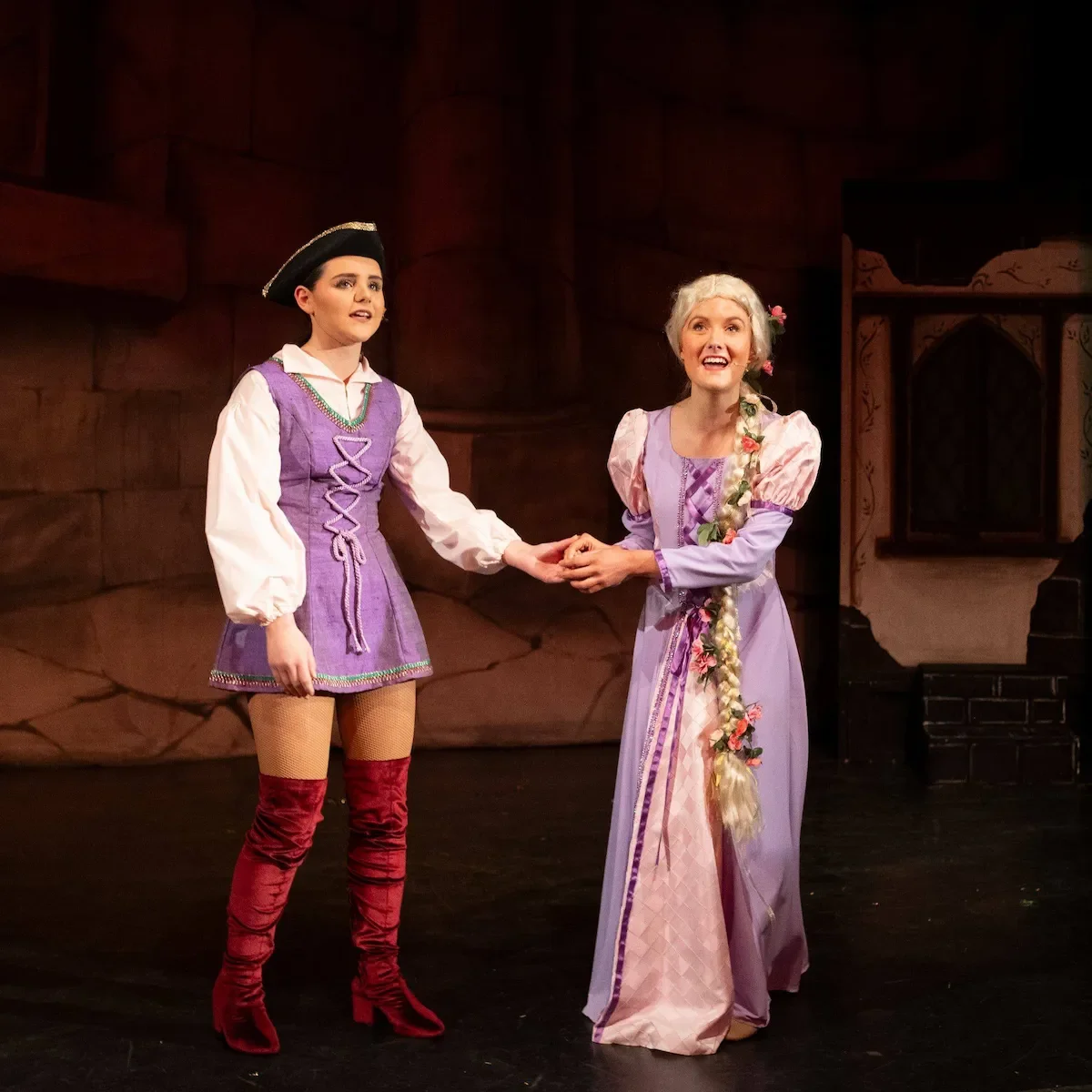
Rapunzel is the title heroine, and our version keeps the fixed elements of the Grimm original intact: magical hair, a tower, a witch who won't let her leave. What she gets that the fairy tale doesn't is spirit. She's the one who spots the potion tray's possibilities in Scene Three, the one who sends Sidney out to find help rather than sitting and hoping, and later the one who turns Gothel's own potions against her at the climax instead of being rescued outright. Too many pantos are built around a damsel in distress, so it felt about time to bring Rapunzel into the 21st century and give her some get up and go, literally.
Prince Leo arrives from the neighbouring kingdom of Tangle-land under pressure from his own matchmaking parents, a framing that gives the couple's meeting real comic momentum before it turns romantic. He and Rapunzel don't fall for each other on sight. They bond over both wanting to escape their families' expectations, which gives their eventual declaration in the tower ('maybe you're the help I need to finally leave my castle', 'maybe you're the help I need to finally leave my tower') a proper emotional set-up rather than an instant, unearned spark.
Dame Betty Beehive, the Dame
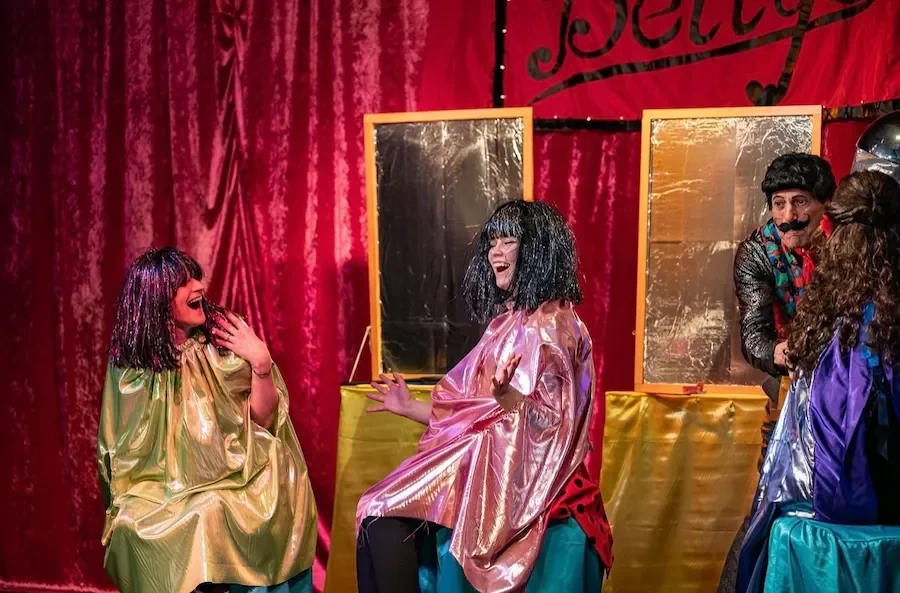
Rapunzel is a relatively recent addition to the panto repertoire, and no single traditional Dame name has attached itself to the story the way Widow Twankey has to Aladdin or Sarah the Cook has to Dick Whittington. That leaves room for invention. Dame Betty Beehive is the flamboyant owner of the Bee Hive hair salon in Quiffendale, terrible at her job and cheerfully unbothered by it.
Her best device is the audience call and response built around her own name, 'I'm up to no good!' met with 'Betty Behave!', which the script asks to be pronounced as a cross between Beehive and Behave. It is simple enough to teach in seconds and gets reused right through to the final showdown in the tower. Underneath the comedy she has a proper thread of her own: a lost knack, a lost love, and a college sweetheart who turns up to remind her what she used to be capable of, which pays off when her hairdressing talent magically returns at the finale.
Silly Billy
Billy is Dame Betty's son and trainee hairdresser, and he does the bulk of the script's audience-facing comic work. He opens the show talking to the crowd, absorbs most of the running hairdressing-disaster gags, and gets an emotionally honest beat when the Ensemble's teasing about his terrible haircuts upsets him, before he bounces back.
The comic son of the Dame is a shape that recurs right across the catalogue: Greg Kipling does the same job in Hansel and Gretel, Idle Jack in Dick Whittington, Simon Trot in Jack and the Beanstalk. Billy fits that mould rather than inventing a new one, which is useful if you're making casting decisions across a season with a director who has staged one of the others before.
Gothel and Sidney
Gothel is the one character in this story fixed by the source material. The Grimm tale names her, and almost every panto version of Rapunzel keeps her. Ours leans fully into vanity rather than simple malice: her entire scheme runs on harvesting Rapunzel's magical hair for beauty potions, and her opening monologue in the Enchanted Forest, reeling off bottles named things like 'Bog-Troll Botox! Just one sip freezes your face in a look of eternal superiority!', is one of the sharper villain set pieces in the catalogue.
Sidney, her son, isn't from the fairy tale at all. He's an original addition and the character with the most ground to cover. He starts the show at Gothel's beck and call and eventually turns the hairspray on Gothel herself rather than freezing the rescue party: 'You've had enough control over Rapunzel's life, and over mine; it ends now.' A henchman or relative who turns on the villain partway through is a device the catalogue uses more than once, and Stinkworth's late change of heart in Hansel and Gretel does similar work, though Sidney's arc runs the whole show and Stinkworth's lands in one final-scene turn.
Drip and Dribble
Gothel's henchmen aren't part of the Grimm story either. They're a pair rather than a single sidekick, which gives the comedy somewhere to bounce, and they're consistently the ones who get things wrong: handing Gothel a laxative instead of a beauty potion, running the wrong way when sent to catch Rapunzel. Bluff and Blunder do the job for the Sheriff of Nottingham in Robin Hood, Slip and Slap serve Octavia in The Little Mermaid, and Grabbit and Runn chase down Baron Hardup in Cinderella. For casting purposes, they get a small redemption beat of their own at the very end, taking over reception duties at the salon once Gothel's reign of terror is done.
Fairy Stardust, Sat Nav and Bob the Barber
Fairy Stardust narrates the story in rhyming couplets and nudges the plot along at the right moments, closer to comic support than a solemn fairy godmother. She also gets the driest lines in the Act Two war council, where she demolishes every royal rescue plan in turn.
Where this script properly departs from tradition is the Sat Nav, an enchanted GPS Fairy Stardust conjures to guide the rescue party through the forest, played voice-only ('Recalculating route… In fifty yards, turn left at the big spooky tree'). It's a close cousin to Alexa, the smart-assistant reimagining of the Spirit of the Ring in Aladdin, a traditional magical helper given a modern, gadget-based twist. Being voice-only, it's a flexible part for a group short on cast, or an easy way to give a backstage voice a moment in the show.
Bob the Barber isn't a traditional Rapunzel figure either. He's our own addition, an old college flame of Dame Betty's who arrives in Quiffendale, joins the rescue party without hesitation, and ends the show proposing to her once her hairdressing talent returns. He's a competent counterpoint to the Dame and Billy's chaos, his running gag being that he fixes every disastrous haircut they've caused, at speed, which makes him a good role for a performer who can play warmth and quiet capability as well as out-and-out comedy.
The Two Royal Families
Quiffendale's King Otto and Queen Agnes are Rapunzel's real parents, present at her kidnapping in the Prologue and again at the emotional reunion in Act Two. Tangle-land's King Reginald and Queen Marjory are Prince Leo's parents, and carry most of the script's farce: a parade of unsuitable marriage candidates in Scene One, and a very funny military-planning scene in Act Two where their rescue strategy runs through a wooden horse, a "Trojan Pigeon", and a royal decree to reduce all towers to bungalow height.
Rascal, Granny Mavis, Mildred and Gertie
Rascal, Rapunzel's pet rabbit, starts the story as a normal-sized prop and becomes a genuine speaking character partway through Act One when Sidney accidentally spills a hair-growth potion over him. It's a good showcase role: written to double as both a straightforward comic pet and, once transformed, a character with his own dry one-liners and a late, unexpected romantic subplot with a transfigured Gothel. Mavis, meanwhile, is a smaller but well-loved recurring part built entirely on one joke (an elderly woman desperate for adventure), and she's worth casting with someone who can land a single-line punchline with real confidence, since her whole part depends on it.
Mildred and Gertie complete the listed supporting roles. They arrive as candidates for the Prince's hand, one with an enormous beard and one who sings very badly indeed, and neither says a word, so they suit two members who will enjoy a costume and a moment rather than a part to learn.
Who These Rapunzel Characters Suit
With 15 named principal characters and four supporting roles, plus a flexible Ensemble of townsfolk, salon customers, guards and ghosts, Rapunzel is one of our pantomime scripts for large casts and notably bigger than most of the rest of the catalogue. Every other title we publish is on the All Scripts page if you want to compare, and our home page has plenty of useful links too.
You can request a free Perusal Script, or visit the Rapunzel script page for the full synopsis and details. If you're already thinking about booking, our Performance Licences page has what you need, and our FAQs cover most of the rest.