
Peter Pan Pantomime Characters: A Complete Guide
Second Star to the Right, and Straight on Till Casting
Peter Pan hands you more named parts than almost any other panto title, so casting it is a scheduling exercise as much as an artistic one. The Peter Pan pantomime characters here run from the Darling nursery to the deck of the Jolly Roger: Dame Smee and her son Hugh on comedy, a Hook undone by his own crew's wordplay, four Lost Boys with four separate jokes, and a fairy who needs two performers rather than one. Below is who carries what, and where you can safely double up.
Peter Pan, Wendy, John and Michael
Peter Pan is the title role, and this version keeps him genuinely flawed rather than simply heroic. He's vain, and the script gives him the line to prove it as he recalls setting the crocodile on Hook: 'Oh, the cleverness of me!' He dismisses Tinker Bell's warning about the poisoned medicine because he'd rather not admit Wendy might be right about something, and his refusal to grow up is played as a real emotional block, not a punchline, right through to the closing scene where Wendy finally talks him into coming home.
Wendy, John and Michael are the three Darling children, and the script gives Wendy in particular a proper arc rather than leaving her as the boys' plus-one. She's the one who reassures Tinker Bell, negotiates Line and Sinker into letting her go, and ultimately talks Peter round at the end. John and Michael carry most of the sibling comedy, including the pirate-crew opening and the running business around Peter's instruction to 'just think happy thoughts and you'll lift off the ground', which makes them a solid pairing for two younger or less experienced performers.
Dame Smee and Hugh
Peter Pan sits outside the usual Dame-led panto tradition altogether. J.M. Barrie's original has no Dame at all, and where productions add one there are two commonly recognised solutions: play Smee himself as the Dame, or invent a new nursemaid figure. This script takes the first option, one of the two genuinely recognised answers to a gap in the source material, rather than inventing something with no basis in the story.
Dame Smee gets a comic engine through her backstory: a former nun with a habit (sorry) of naming her old convent friends after puns. The smartest woman she ever met was Nun Wiser, the most courageous Nun Braver, the quickest Nun Faster, and the world record holder for the fastest woman to slice cheese was Nun Grater. It gives her opening monologue plenty to work with before she's even introduced the ship. Hugh, her son and the pirate crew's newest deckhand, carries the audience call and response, teaching them that when he says 'Ahoy me hearties' they reply 'Ooh Argh!', and he slots into the same comic-son-of-the-Dame mould that runs through the catalogue, alongside Silly Billy in Rapunzel and Greg Kipling in Hansel and Gretel.
Captain Hook
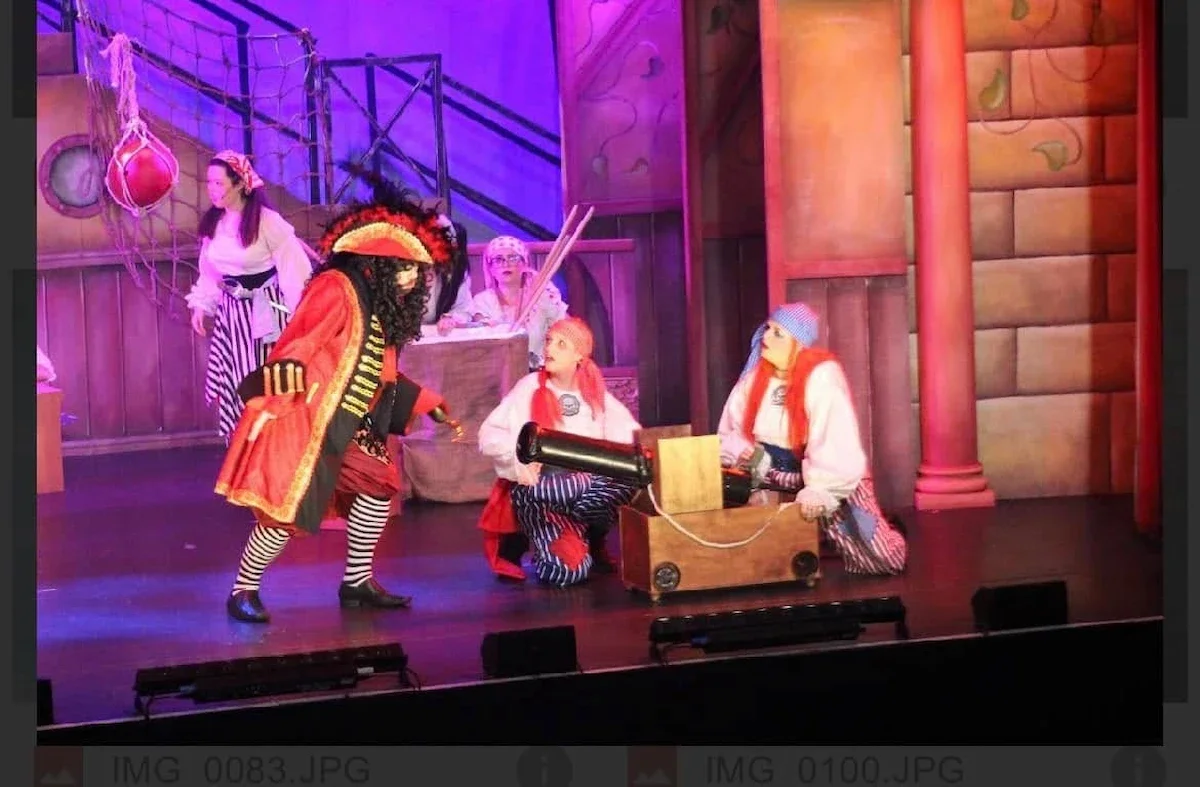
Captain James Hook is one of the few fixed elements of the whole story. Every panto Peter Pan keeps him as the villain, hand-hook and crocodile grudge intact. This version leans into pure comic self-importance rather than real menace: he's constantly undone by his own crew's wordplay, in the 'Hook, Line and Sinker' introductions and the cannon-ball confusion, and his eventual defeat comes from hearing a ticking sound and bolting, not from a sword fight, in a running gag about the clock-swallowing crocodile that pays off twice, once as a fake-out with Hugh and a table tennis bat, and once for real at the climax.
Line and Sinker
Line and Sinker are Hook's crew and their entire comic engine is taking his instructions with complete, misplaced literalness: weighing the anchor in pounds, trying to 'line up' a cannon by fitting inside it. Their gag is built on literal-mindedness specifically, which makes them a good fit for two performers with sharp, deadpan timing rather than pure physical comedy.
Tinker Bell and Tinker Bill
Tinker Bell is fixed by the JM Barrie’s source material, but this script gives her a unique staging solution: a body double, Tinker Bill, deliberately cast as someone visibly different, who lets the fairy zoom from one place to another at impossible speed. The audience is in on the joke and the characters aren't. It’s a very silly and very short cameo role that gives a second performer a proper comic role while solving a real staging problem, and it's one to plan for early, since it needs two identical costumes in different sizes.
Tootles, Slightly, Curly and Nibs
The four named Lost Boys aren't interchangeable background here. Tootles gets the cheek and the confidence, needling Slightly about outrunning him. Slightly carries a nervous streak that pays off as a running gag around the crocodile. Curly is the one who wants Wendy's bedtime story, and Nibs gets the script's frog-and-toad-in-the-hole pun exchange. Cast four distinct comic voices and you get considerably more out of this part of the script than treating it as flexible ensemble would.
Mr and Mrs Darling
Present only in the opening scene, Mr and Mrs Darling do real thematic work before they disappear from the story. Mrs Darling's warmth and Mr Darling's sternness set up exactly the kind of home life Peter claims he doesn't want, which is what makes Wendy's offer of a mother land later, and what makes Peter's own admission that his mother doesn't want him hit harder by contrast. While many versions dictate that Mr Darling is played by the same actor who plays Captain Hook, this isn’t strictly necessary, but is an easy way to double up if you need to.
The Crocodile and the Mermaid
The Crocodile is Hook's non-speaking nemesis and the story's actual mechanism of victory. Peter lands the final line of dialogue, but the script is careful to give the credit elsewhere: Wendy's 'No Peter, the Crocodile saved the day' leads straight into Dame Smee calling for three cheers. It's an understated bit of writing that rewards a director who plays the costume for real comic presence rather than treating it as a prop gag. The Mermaid, or Mermaids, are written flexibly by design; the Author's Notes leave the casting and staging up to you, including the option of playing it as a comic Dame-style number instead of a straight musical moment.
Who These Peter Pan Characters Suit
Peter Pan runs to 14 principal characters and five supporting roles, plus the flexible Mermaid and the non-speaking Crocodile, which puts it firmly among our pantomime scripts for large casts. If you're comparing titles, the full catalogue is on our All Scripts page, and our home page is the quickest way into everything else.
With two licences to arrange and 19 named parts to fill, this is one to start on early. Request a free Perusal Script, or visit the Peter Pan script page for the full synopsis and the additional licensing information noted at the top of this post. When you're ready to book, our Performance Licences page has the rest, and our FAQs cover most of the questions that come up first.
A note before you cast: if your performance is taking place in the UK, you'll need an additional licence from Concord Theatricals, on behalf of Great Ormond Street Hospital (GOSH), alongside your NLP Performance Licence. This is a legal requirement under UK copyright law and can take time to organise, so we’d recommend you apply for it early. Full details are on our Peter Pan script page.