
Dick Whittington Pantomime Characters: A Complete Guide
The real difference between our Dick Whittington pantomime characters and most other versions is a cat who actually gets to talk. In most tellings Eileen would stay silent throughout. Ours gives her a voice, and a fair share of the script's best lines with it. Here's who you'll be casting.
Dick Whittington and Alice Fitzwarren
The bones of this story are old. The real Richard Whittington married a woman named Alice Fitzwarren, and the 'streets paved with gold' legend that sends a poor lad to London, cat in tow, dates back to at least the early 1600s. Our script follows that shape closely: Dick leaves the fictional village of Tiny Tiddlington, falls for Alice within his first scene in the city, and eventually clears his name to become Lord Mayor.
Where we've had our own fun is in the ending. Rather than the Alderman simply granting his daughter's hand, he stops himself and tells Dick 'it's not the old days, you need to ask her, not me!', handing the proposal to Alice's own choice rather than her father's permission. It's a small structural decision, and not something tradition hands you.
The comic engine of their courtship is Dick's escalating compliments ('you're beautiful... beautiful, incredible, gorgeous and absolutely stunning') and the audience-participation hunt for Eileen, who keeps appearing and vanishing right behind them. Both need a cast who won't rush the audience's replies.
Sarah the Cook
Sarah the Cook has been the Dame in this story since the earliest recorded productions, sometimes as Dame Durden, but Sarah the Cook is the name that stuck. Ours, Sarah Snafflebratt, sits squarely inside that tradition while expanding it from cook into full restaurateur, which gives her a much bigger stage than the role usually gets. The Pantomime Dame guide explains why we build every Dame around a trade.
Her running gag with the audience, 'Coo-ee!' answered with 'Show us your sausages!', recurs right across the script and should be rehearsed as a proper callback, not a one-off bit. The same escalating structure shows up in her international menu list, delivered once at normal speed and then faster and faster, with Idle Jack interrupting each time to point out what they've run out of: 'Actually mum, we're out Yorkshire puddings.' She’s a classic Dame with a Trade, just like Dame Trot in Jack and the Beanstalk or Dame Kipling in Hansel and Gretel.
Idle Jack
'Idle Jack' is one of the most fixed comic names in the whole Dick Whittington tradition, Sarah's lazy son, and ours plays it dead straight. He falls asleep mid-sentence, rolls off his cart, and gets caught out twice by a running 'there's no catch' gag with a ball thrown at him from the wings. He has less stage time than Dick or Sarah, but a good Jack needs sharp physical comedy timing more than lines, so cast for that and not for presence.
King Rat, Frank and Sammy
King Rat as villain is fixed by tradition, and ours matches it exactly. What's distinctively ours is the pathos underneath the menace: his tragic backstory, in which a cat named Julie ate his parents while he waited for her at the park, turns his hatred of cats into something almost sympathetic before immediately undercutting it with a joke. Play that beat for real feeling before the punchline lands..
Frank and Sammy, his hench-rats, are a genuine double act rather than interchangeable villain muscle, forever wanting to sing and forever getting shut down, until Fairy Bow-Bells reforms them at the end and sends them off to join a jazz club instead. A henchman duo working for a single villain is a device we come back to across the catalogue: Bluff and Blunder do the same job for the Sheriff in Robin Hood, and Drip and Dribble do it for Gothel in Rapunzel. Give the villain a double act rather than a lone sidekick, and the comedy has somewhere to bounce between two performers instead of landing on one.
King Rat as villain is fixed by tradition, and ours matches it exactly. What's distinctively ours is the pathos underneath the menace. He tells Dick about falling in love with a cat called Julie, from another species, so he knew it wouldn't be easy; he waited for her at the park one day and she never came, and when he finally gave up and went home he found that 'Julie had eaten my mum and dad!' Dick's genuinely shocked apology is met with a flat 'As if you care', and the scene snaps straight back into villainy.
Frank and Sammy, his hench-rats, are a genuine double act rather than interchangeable villain muscle, forever wanting to sing and forever getting shut down, until Fairy Bow-Bells reforms them at the end and sends them off to join a jazz club instead. There not too dissimilar to Robin Hood’s Bluff and Blunder, and Rapunzel’s Drip and Dribble.
Eileen and Fairy Bow-Bells
Eileen isn't handed to you by tradition the way Sarah or King Rat are. In most versions of this story the cat stays a cat; ours gives her a voice, a personality, and the negotiation that ends the whole plot. The spell that lets her speak, cast by Fairy Bow-Bells and tied to staying on the road to London, is entirely our own invention, so flag it to a cast and an audience instead of assuming anyone expects a talking cat here. Once she can talk, Eileen does real narrative work: she single-handedly defeats the Rat Pack offstage, then talks King Rat down at the climax with a straightforward cat-to-rat peace offer built entirely on cheese, having noted that his nose has been out of joint ever since the deli ran out of it. She needs an actor confident enough to hold the stage alone during that scene.
Fairy Bow-Bells is where the name itself is the tradition. In the London legend it's the bells of Bow Church that ring out 'turn again, Whittington' and call Dick back to the city, and 'Fairy Bow-Bells' is the long-established pantomime solution for turning that piece of folklore into a character. She sits in the same guide-and-helper role as Fairy Haricot in Jack and the Beanstalk, closer to a fond nudge in the right direction than a solemn fairy godmother.
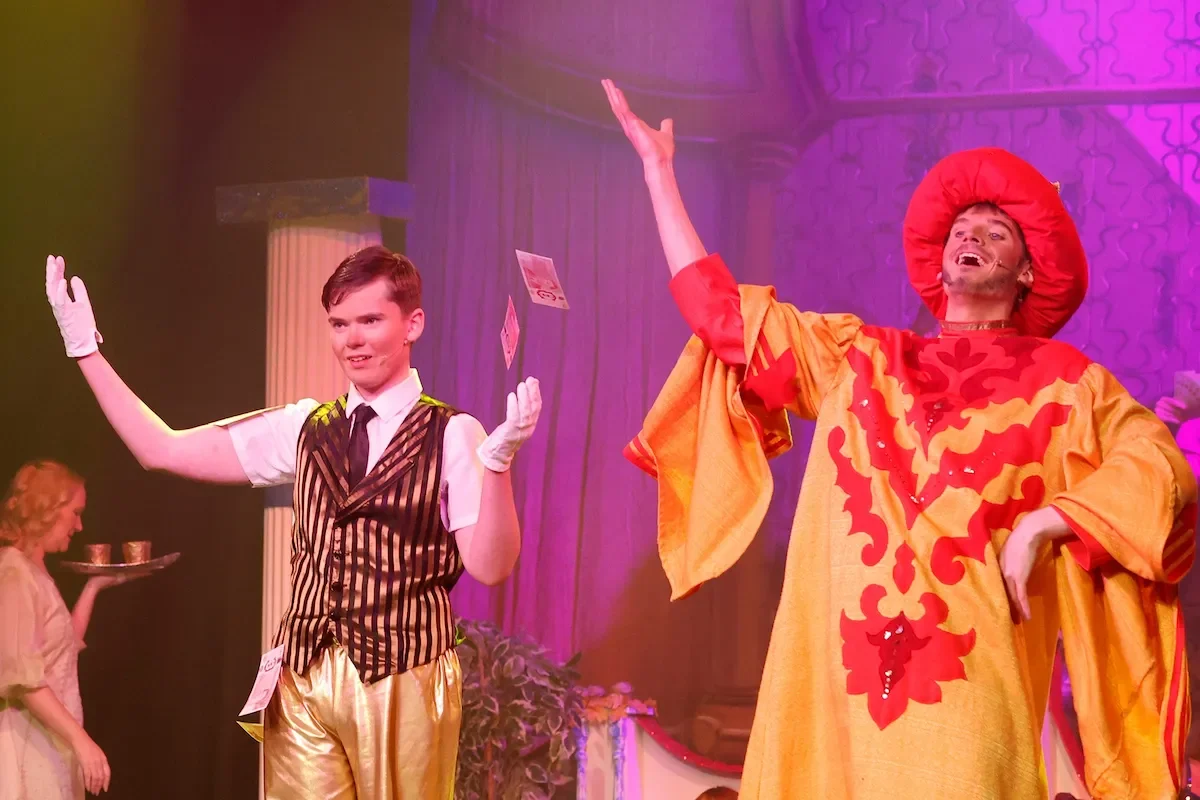
Alderman Fitzwarren, Captain Watt and Sultan Pepper
Alderman Fitzwarren, Alice's father and the council leader, carries the story's authority-figure role and its subplot. He's the one taken in by King Rat's necklace frame-up, and the one who has to admit he was wrong. Captain Watt has no fixed traditional name, since the ship's captain has always been a blank slate for panto writers to fill however they like, and ours leans into a crossed-wires routine built entirely on his own name, then leads the mop drill in Scene Eight, a physical set piece to rehearse separately for timing. Sultan Pepper is a smaller role confined to Act Two, mostly there to be menaced by King Rat and rescued at the end, so it can comfortably double with an ensemble track on a tighter cast.
Casting the Dick Whittington Pantomime Characters: Who It Suits
With 11 named principal characters and two supporting roles, plus a flexible Ensemble of townsfolk, sailors, rats and pest controllers, this sits in our Medium Cast scripts. The rest of the catalogue is on our All Scripts page, and our home page will take you to everything else.
Eileen holds the stage alone for the scene that ends the plot, so cast her carefully, and read that scene first. Request a free Perusal Script, or visit the Dick Whittington script page for the full synopsis and details. Our Performance Licences page has the booking detail when you need it.