
Pantomime Set Design and Costumes
Pantomime set design and costumes are something I think about a lot, both from the writing side and from being in the room for productions I’m personally involved with as a director or MD. The pattern I see most often has nothing to do with budget. It’s that nobody on the team has actually decided what the stage should look like, so it ends up dressed by whoever had time that week rather than by choice.
What Your Scenery Actually Has to Do
Pantomime scenery does not need to be photographically real. It needs to be readable at a glance, so the audience knows whether they are in a palace, a kitchen, a forest or a cave before the dialogue tells them.
At the simpler end of the budget, a star cloth and a handful of well-chosen props suggest an enormous amount. Party flags and tinsel define a space cheaply, and a painted back wall in two or three colours establishes a location without real complexity.
I write front-cloth scenes into every script for this reason: the Dame’s monologue, a comic double act, a courtship scene, built to run in front of the tabs while a full set changes behind them. They hold the stage because the writing is confident, not because of anything happening behind the curtain.
Kitchen and bakery scenes turn up right across the catalogue, and there’s a reason for that beyond convenience. Dame Kipling’s Bakery in Hansel and Gretel, Dame Babs’ Kitchen in Snow White and Duchess Battenberg’s Royal Bakery in Alice in Wonderland are all built from the same practical kit: a table, a large mixing bowl, a flour bag, an apron. If your society already owns that kit from a previous production, it works again almost as it stands, which is one of the more useful things about how often this particular setting recurs.
The Same Backdrop, Different Light
Lightweight flat-built scenery, foam board and MDF, both paint up well and store between seasons if someone in the company is handy with tools. The bigger saving is often lighting rather than building. The same flat can read as two or three different places depending on what you put on it. A good example of this can be a stone castle wall, or a backdrop that looks like any Market Square or Town Centre.
The forest recurs across Hansel and Gretel rather than appearing once: a front-cloth comic walk-through played straight, the ‘it’s behind you’ ghost gag on the same front-cloth setting, a full-stage number for the ghosts and skeletons with the stage dimly lit, which the script itself flags as a great opportunity for UV lighting, and a later return to the same location played dark and spooky for a different scare. Four different feels from what can be one built piece, mostly through what the lighting is doing rather than what gets rebuilt. Robin Hood’s Outlaws’ Camp is built on the same idea from the other direction. It is still a forest, but dressed full-stage with a campfire, so a company that already owns a forest backdrop is most of the way to both.
Two Actors, One Costume
Some scripts pose the opposite problem and ask you to make the same costume twice. In Peter Pan, Tinker Bell has a body double, Tinker Bill, who exists purely for a gag about how fast she can move. Tinker Bell runs offstage one side and Tinker Bill appears somewhere else entirely a moment later. While this gets a great laugh just on the premise, I’d suggest casting Tinker Bill as someone who looks completely physically different to whoever’s playing Tinker Bell to get that extra laugh. This therefore requires a second costume that is identical in design, but suitable for a different actor’s size.
In Goldilocks and the Three Bears, Charlie and Cooper the clowns go further still: in some scenes they are both onstage together, played by an actor and a double in identical costumes, and a red wig or a blue wig is the only thing telling the audience which is which. Two of the same costume, not one costume reused, and the wig is doing the cheap half of an otherwise doubled cost.
Some costumes, however, are worth hiring especially rather than attempting from scratch. A full animal costume is usually one of them. The Three Bears are one example, and Pat the Cow in Jack and the Beanstalk is another, a costume built for two performers sharing one skin, which is exactly the kind of specialist build a theatrical costume hire company will already have solved.
Delegate the Costume Picture Properly
The most useful thing any production can do with costumes is have one person, whether that’s the director, a set designer or a dedicated costume lead, holding the overall picture in their head, even if they aren’t sourcing or making every item themselves. It’s a delegation question as much as anything, using the people you already have and the stock your society already owns rather than starting from nothing each time.
Everyday items go further than they look once someone is thinking about the group as a whole. Waistcoats, leggings, plain skirts and cheap high street shirts can be dyed or accessorised into something that reads as a period costume or a themed uniform. Charity shops, car boot sales and resale marketplaces are worth checking before buying anything new, and theatrical costume stock circulates fairly reliably through those channels.
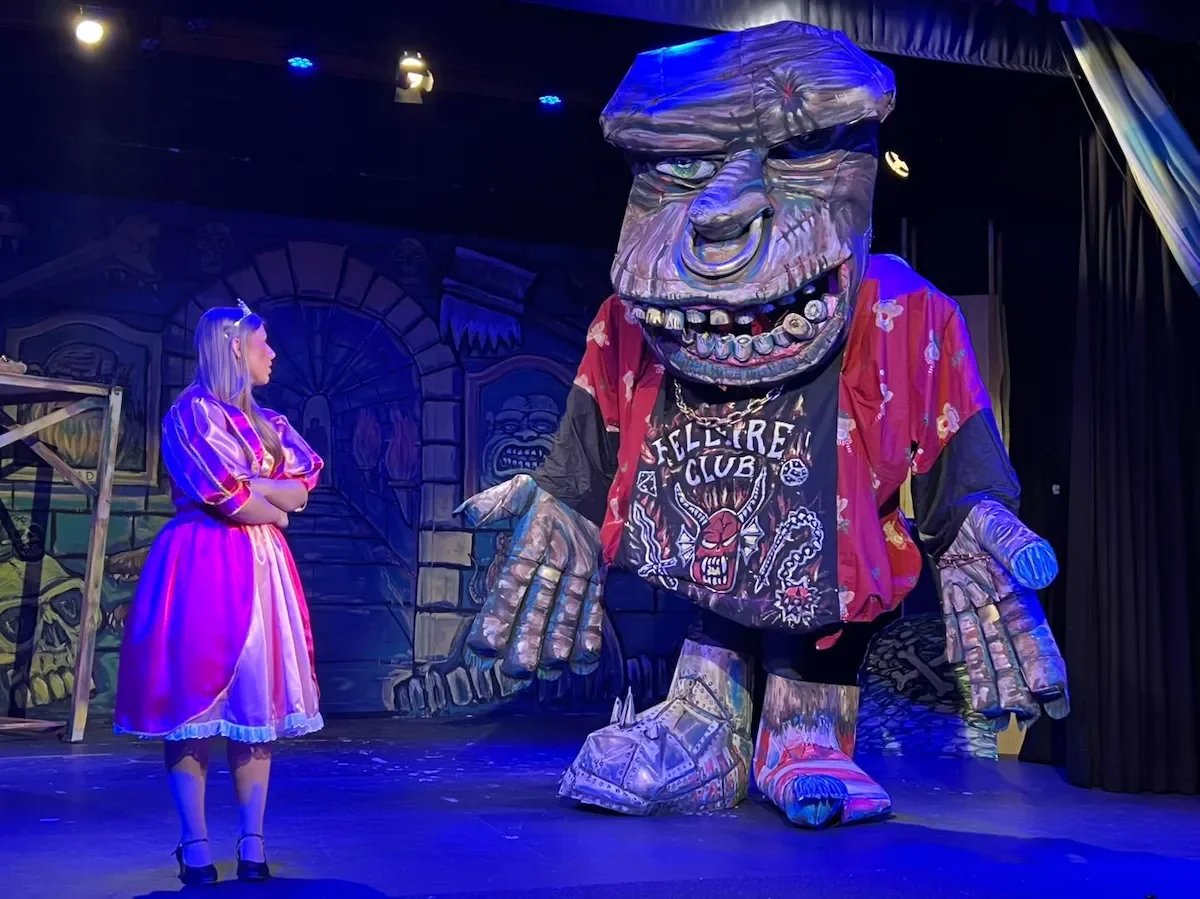
The photograph here is from a Jack and the Beanstalk production: Princess Jill in a simple, coherent principal costume, next to a Giant built from exaggerated proportions rather than expensive fabric. The size difference alone tells the audience everything it needs before either character speaks.
For a pirate crew or similar ensemble, a job lot of striped t-shirts from a cheap supplier and a few bandanas will read perfectly well from the stalls, and the same goes for townsfolk, who look great in a themed set of costumes that can often be everyday shirts and skirts with panto appropriate accessories.
Spend Where the Audience Is Actually Looking
Budgets are almost always limited, so concentrate what you have on the costumes the audience spends the most time looking at.
The Dame’s costume matters more than almost anything else in the show. She is onstage for a large share of the evening, and the costume gets its reaction by being loud, exaggerated and completely committed, not by being restrained.
When I wrote Dame Betty Beehive as a hairdresser running a salon out of Gothel’s tower for Rapunzel, the costume depends entirely on matching that premise: rollers, a nylon housecoat, something going catastrophically wrong with a wig mid-scene. Read the script for what the Dame actually does before deciding what she wears, and the costume tends to follow naturally.
The principal costumes deserve the same attention at first entrance, where the audience decides what to expect before a line is spoken. A villain like Madam Meanie in Goldilocks and the Three Bears needs a costume that reads as a genuine threat, not a black cape doing all the work on its own.
The Detail Audiences Actually Remember
The details that register are rarely the ones a budget gets spent on. Headwear, footwear and anything at eye level for the front rows are what people notice.
Hats in particular punch well above their cost and props can add a lot too. Giving a villain a distinctive hat, or getting the right sort of magic wand for a fairy can make all the difference and can often be easy to source, or can be made by accessorising something from a charity shop. other things work the other way, a pair of modern trainers looks out of place, or jewellery can be distracting. While it’s important to get the big things right, ensure the little things are spot on too.
If you want to see how a specific title’s cast and staging actually breaks down before deciding what any of this will cost, request a free Perusal Script and read the character list and scene breakdown yourself. You will find the full catalogue on the home page or the all scripts page, and I’m always happy to talk through a staging or costume question directly too.