
Know your Dame from your Villain (and everything in between)
Every pantomime script tells a different story, but they all do it with roughly the same cast of characters. The Dame, the Villain, the Principal Boy and Girl, the Comic, and the Good Fairy are the recurring types that give the form its shape and much of its energy. They are not clichés to be apologised for. They are a theatrical vocabulary, refined over more than two centuries of performance, that audiences understand instinctively and respond to with remarkable consistency.
Understanding what each character type actually does, in the story and in the room, is one of the more useful things a director or writer can bring to a production. This guide covers all of the major stock characters in a pantomime, what their function is, and what conventions tend to travel with them.
The Dame
The Dame is pantomime's most distinctive contribution to theatrical character types, and the one most resistant to summary. At first glance, she is a man playing a woman playing a fool. In practice, she is the emotional centre of almost every show and this can be seen across most panto scripts from Aladdin’s Widow Twankey to Dame Beluga in The Little Mermaid.
The Dame is almost always a comic character and almost always played by a man, though neither of these is an absolute rule. What is constant is her relationship with the audience, which is warm, direct, conspiratorial, and frequently chaotic. She speaks to the house freely, shares her opinions without much restraint, and treats the audience as co-conspirators rather than observers. Her humour is broad and physical, her costumes are outrageous, and her dignity is permanently in question, but her heart is reliably in the right place.
The Dame's story function is typically a maternal figure connected to the hero: a mother, a guardian, an aunt. This gives the comedy a structural anchor. She is not present purely for laughs. She has stakes in the story, and the audience's affection for her is tied to their concern for the characters she loves.
The costume and make-up conventions of the Dame are a tradition in their own right. They are bright, overstated, and deliberately mismatched. The joke is partly in the gap between her self-perception and the reality visible to everyone else. A well-played Dame never believes herself to be ridiculous, which is a significant part of what makes her so.
The Principal Boy
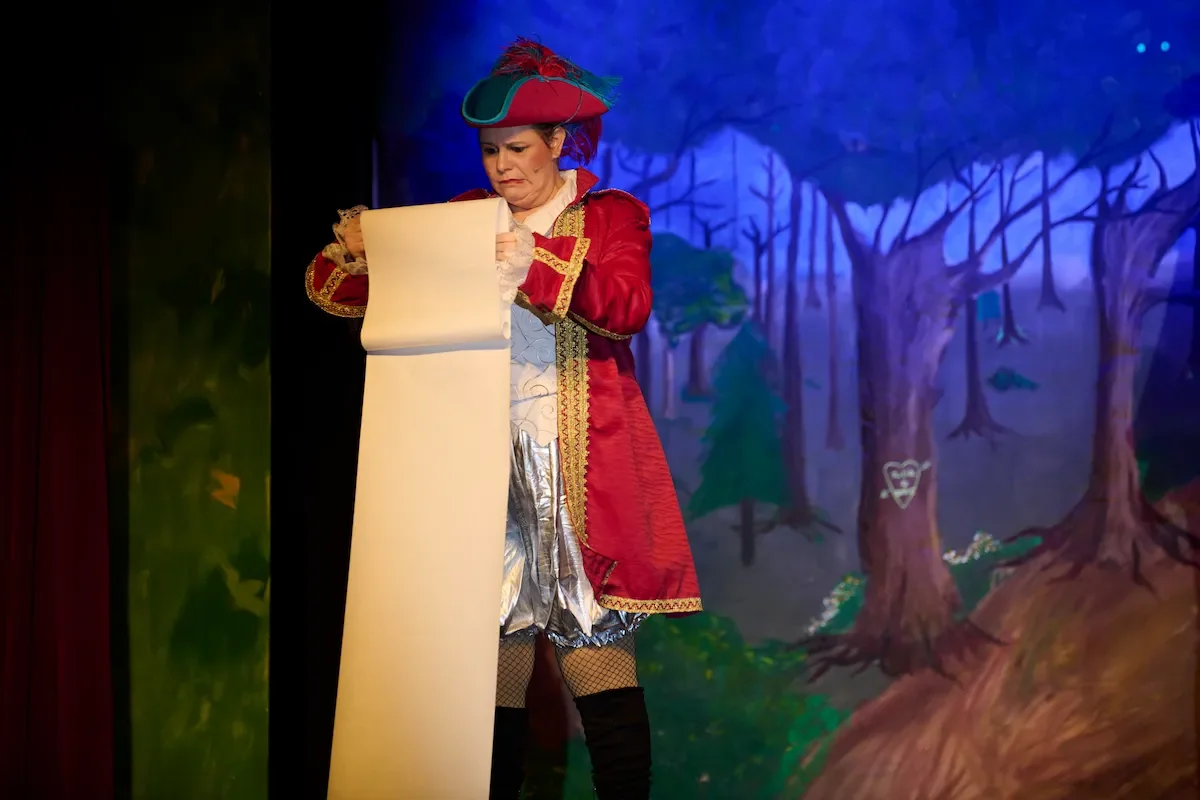
The Principal Boy is the hero of the story, the young man who rescues the girl, slays the giant, defeats the villain, and generally sets the world right before the finale. The traditional convention is that this role is played by a woman, typically in breeches, which is one of the older and more elegant inversions in the pantomime tradition.
The cross-gender casting has roots in the Victorian music hall, where female performers in leggy costumes playing romantic male heroes were a reliable draw. The tradition persisted, and the Principal Boy became a defined role with its own performance conventions: confident, upright, slightly earnest, physically capable, and heroic in a way that is not played for laughs.
In more recent productions, the convention of female casting has sometimes been relaxed, and Principal Boys are more frequently played by men, particularly in community productions where casting availability matters more than tradition. Neither approach is incorrect. The character's function, a brave and resourceful young hero who drives the main plot forward, remains the same either way.
The Principal Boy tends not to be a comedian, although Peter Pan and Robin Hood are notable exceptions. The role exists to carry the story and to make the audience care about what happens. It is a more internally consistent character than the Dame or the Comic, which means it requires a different kind of performance skill, commitment over mugging, sincerity over winking.
The Principal Girl
The Principal Girl is the female lead, the romantic partner of the Principal Boy, and very often the character in greatest need of rescue at the beginning of the show. Cinderella, Sleeping Beauty, Snow White in her various forms, and the heroines of many other traditional titles all sit in this role.
The Principal Girl is not a passive character, though the traditions of the form have sometimes made her look like one. Her function in the story is to be the emotional heart of the narrative: the character whose situation creates the stakes, whose happiness the audience is rooting for, and whose reunion with the Principal Boy provides the story's resolution. In well-written pantomimes, she is resourceful, warm, and capable within the constraints of her circumstances.
I’ve made a point of ensuring many of my Principal Girl’s have agency and aren’t resigned to being damsels-in-distress, most notably Beauty in Beauty and the Beast, Maid Marian in Robin Hood and the titular Rapunzel.
The Principal Girl's relationship with the audience tends to be sincere rather than comedic. She plays it straight, which is why the character works. In a form that values silliness very highly, genuine emotion needs at least one reliable home, and the Principal Girl is usually it.
The Villain
The pantomime Villain has one of the most satisfying roles in the form: absolute moral clarity, terrific costumes, an audience who will boo on sight, and usually a comic henchman for company. The job is to be bad in ways the audience can enjoy, which sounds simple and is actually quite specific.
The Villain exists to create the problem the Principal Boy must solve. Without a witch's curse, a sorcerer's plot, an evil stepmother's cruelty, or a warlord's ambition, there is no pantomime story. The Villain provides all of the narrative tension and most of the theatrical excitement. They are frequently the best-dressed character on stage.
The performance conventions for a Villain are distinct from comic characters and heroic ones. Villains tend to address the audience directly with menace rather than warmth, taking the house into their confidence in a way that flatters the audience's intelligence while staging their own wickedness. A Villain who makes the audience laugh while making them boo is doing exactly the right thing. The audience should relish being the Villain's enemy.
Villains often have a moment of apparent triumph in Act Two before their inevitable defeat. That matters structurally, because a Villain who poses no real threat generates no tension. The worse things look before the resolution, the more satisfying the ending. The pantomime form trusts its audience to understand this, which is why it can go quite dark without anyone losing their bearings.
The Comic
Most pantomimes include a comic supporting character who is distinct from the Dame and provides comedy in a different way. This character tends to be younger and more naive: well-meaning, easily confused, occasionally brave in ways they do not quite intend, and reliably funnier for not being in on the joke. Personal favourites are Idle Jack in Dick Whittington and Greg Kipling in Hansel and Gretel.
The relationship between the Dame and the Comic is one of pantomime's most productive double acts. Their scenes together carry much of the broad comedy in the middle sections of a show, and a well-matched pair, with good timing and rapport, can lift the whole production. The dynamic is almost always the same. The Dame is larger-than-life but not quite as foolish as she appears, and the Comic is cheerfully oblivious.
The Silly Billy role is sometimes the hero's sibling, sometimes their friend, sometimes a servant or sidekick. The story function varies. The comedy function does not change. It is to be wrong at the right moment, to be brave when it costs something, and to get the Dame into trouble.
Fairies and Magical Beings
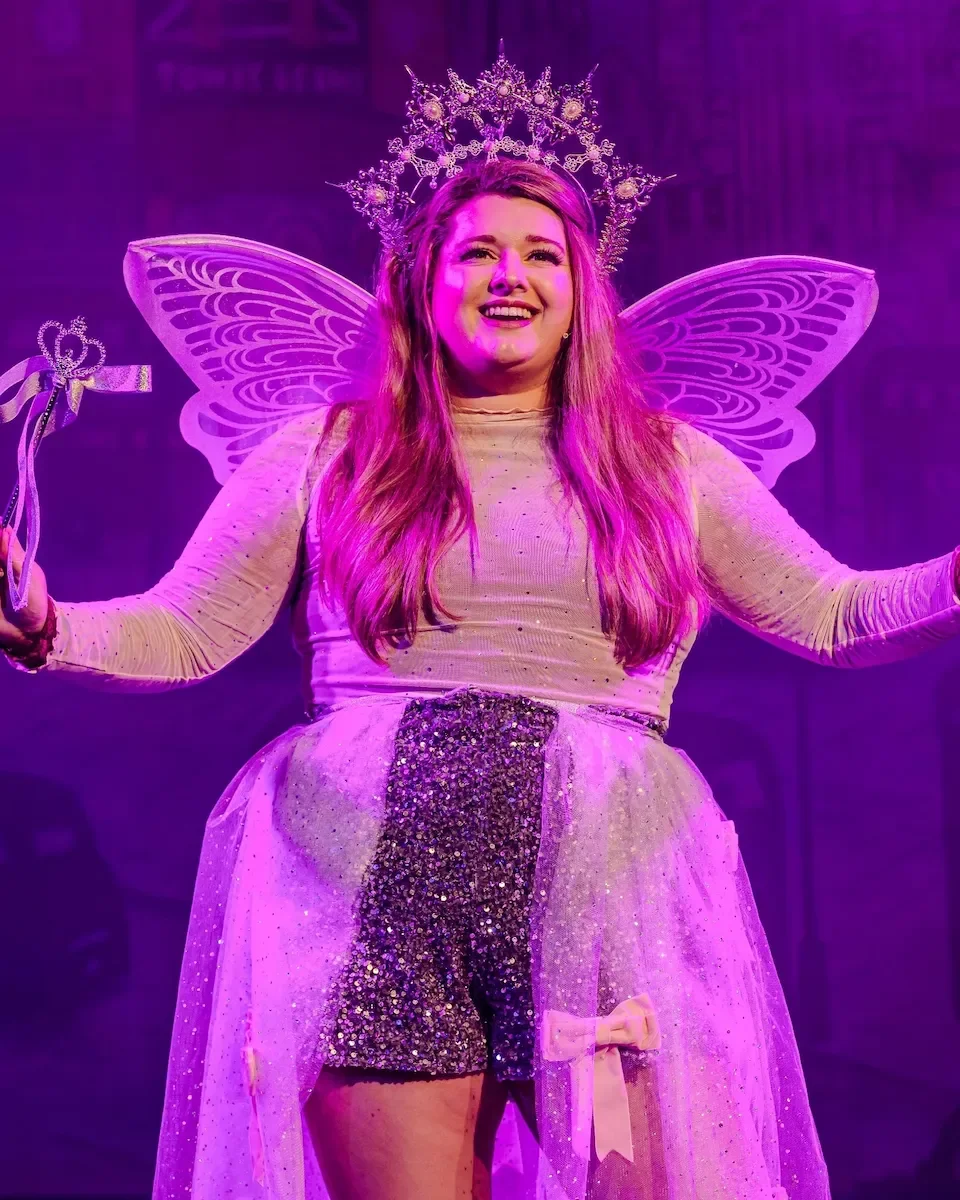
Many pantomimes include a supernatural guide, or Good Fairy, who assists the hero and some also have a corresponding supernatural antagonist who assists the Villain. These roles have their origins in the Harlequinade tradition that predates modern pantomime, and the formal convention of the "good fairy" and a dark equivalent has been part of the form since at least the nineteenth century.
The Good Fairy's function is partly narrative, providing magical assistance and exposition, and partly structural. In the traditional pantomime, the Good Fairy would address the audience directly in rhyming couplets, establishing their opposing roles and the terms of the central conflict. This convention survives in many productions, though it is handled differently across different pantomime script titles and styles.
Examples of Magical Beings are Tinker Bell (and Tinker Bill!) in Peter Pan, and The Spirit of the Ring in Aladdin.
Magical beings tend to appear at key moments: the opening, to set the story in motion; at a crisis point, to provide guidance or a magical object; and at the resolution, to restore order. They are not a character in the same psychological sense as a Principal Girl or Villain, but rather a rhyming storyteller to ensure the plot isn’t lost within the comedy.
The Spirit of Evil, where present, serves a corresponding role in the Villain's story, giving a supernatural endorsement of their wickedness and often providing magical assistance. Not every pantomime includes a distinct Spirit of Evil as a separate character; sometimes the Villain is supernatural enough to serve both functions.
Sidekicks and Henchmen
Most Villains have a sidekick or a pair of comic henchmen who carry out their orders with varying degrees of competence. This character type has deep roots in the form and serves several functions at once.
Henchmen provide a bridge between the Villain's menace and the audience's amusement. They can be silly while the Villain is frightening, which allows both registers to coexist. They are also available for physical comedy, audience participation games, and the kind of broad slapstick that would undermine a Villain if they did it themselves.
In titles with a more comic henchman dynamic, there is often a running gag structure built around the henchmen's incompetence, their fear of the Villain, or their gradual change of heart toward the end of the story. A henchman who defects to the side of good in Act Two is a reliable emotional beat, particularly with younger audiences.
Animals and Other Character Types
Some titles include ensemble character types with their own conventions: the Broker's Men/bailiffs (in Cinderella), Pat the Cow (in Jack and the Beanstalk) and Eileen the Cat (in Dick Whittington), and various animal characters who appear in specific stories. These are not universal stock characters in the way the Dame and the Villain are, but they carry their own conventions within the titles they inhabit.
Animal characters in particular, whether a pantomime horse, a cat, a giant, or a talking donkey, occupy a peculiar and productive space in the form. They allow physical comedy and audience engagement that human characters cannot quite access. A well-played pantomime animal, often requiring two performers and a good deal of rehearsal, can be one of the most memorable things in a production.
How the Characters Work Together
The stock characters of pantomime are not interchangeable pieces. They have specific relationships to each other and specific relationships to the audience, and the form's energy comes from those relationships running simultaneously.
The Dame and the Comic play to the audience with warmth and chaos. The Villain plays to the audience with menace and conspiracy. The Principal Boy and Girl play to each other and to the story, providing sincerity in a form that needs it. The Good Fairy holds the moral framework steady. These registers complement each other, and an audience that has been laughing hard at the Dame is better primed to feel the threat of the Villain and the stakes of the Principal Girl's situation.
That is the real intelligence of the pantomime tradition. It is a complete theatrical system, in which each character type serves the others and the whole adds up to something that is, at its best, affecting as well as funny.
Understanding the stock characters well is one of the best preparations you can make before going into a production, whatever role you are playing in it. If you are at the stage of choosing a script, you can browse our full catalogue of pantomime scripts and request a free Perusal Script for any title that looks like the right fit. Our home page is the place to start if you want to see how the rest of it fits together.