
Beauty and the Beast Pantomime Characters: A Complete Guide
Seven Principals, Four Of Them Furniture
Casting the Beauty and the Beast pantomime characters means finding seven principals, fewer than any other script we publish, and four supporting roles that are all pieces of furniture. It also means deciding how many guards you can put onstage at once, because Scene Three gets funnier the more of them there are. Beauty and Prince Lucian meet and fall in love before the witch transforms him, so the Beast spends the whole show being loved by somebody who does not recognise him. Here's the company, and what each part asks for.
Beauty and Prince Lucian, the Beast
Beauty is really Belle, and only nicknamed for her looks. She and Lucian meet in the woods in Scene Two, she gives him the single red rose she was taking home to her mother, and that rose is what later tells the others who the Beast really is.
She is not traded to the castle and does not arrive as anyone's ransom. Dame Dotty makes the promise, Malignia hypnotises her into forgetting it, and Beauty then chooses to go on her own account once she understands the prince is missing. She turns the Beast down when he first orders her to stay, comes back to apologise for storming off, and delivers the declaration that breaks the curse while believing he is already dead. The part needs someone who can hold a genuinely quiet scene in the middle of a pantomime.
Lucian can be played by one actor or two, whichever suits your group, and our character list says so directly. He is funniest when he is being self-aware about his own love story: 'we sang a song together and talked for at least three pages of script!' The dinner scene in Scene Ten has him order the all-day breakfast without the egg, bacon, sausage, tomato, hash browns or beans, and Jeeves brings him an empty plate.
Dame Dotty Doolally and Brian
Dame Dotty is mother to both, and her set piece is a money-counting routine with King Duncan that most groups will recognise the shape of and few will have seen done this well. She counts his own fifty pounds back to him, using his answers to her questions as the numbers, and finishes the transaction owing nothing. Then Brian tries it, and the King leaves 30 pounds down on where he started. It’s a two-hander that runs on nothing but arithmetic and nerve, and it wants a Dame who can keep a completely straight face.
She gets a second solo run in Scene Nine, unpacking a rucksack of increasingly alliterative kit, and when challenged on why a torch would need to be twinkling and turquoise she explains that otherwise it won’t fit the alliteration. She’s also last on her feet in the ghost scene, and she ends the show engaged to the King.
Brian is Doolally by name and by nature, and the show runs a patient joke at his expense from the first minute to the last. The town suggests that if he were cleverer they could be called Beauty and Brains, and Brian's contribution is that there is no 'I' in brains. He is then the one who works out that the Beast is Prince Lucian, from the rose and the timing, which prompts the payoff: 'Perhaps it is Beauty and the Brains after all!' He also turns out to be immune to hypnosis, on the grounds that there is not enough there to hypnotise. He leads the songsheet with Jeeves.
Malignia
Most versions of this story leave the curse unexplained, so having a witch cast it, and giving her a reason, is our own structural choice. Malignia curses Lucian because he refuses to marry her and then calls her ugly, and she knows the second half is the part she has a case about: 'I may well be a wicked witch but morally I'm right; you shouldn't judge people by what they look like.'
She casts in rhyming couplets, hypnotises the King in Act One and Dame Dotty in Act Two, and stays onstage driving the plot rather than disappearing after the transformation, which is the practical difference for a director. She’s taken by a citizen's arrest from the Ensemble because the King has no guards left, and she takes a couplet of her own in the walkdown. This is a big, sustained villain part with several spell speeches to learn, and it rewards someone who can be genuinely menacing and then argue with the audience about the morality of it.
King Duncan and the Guards
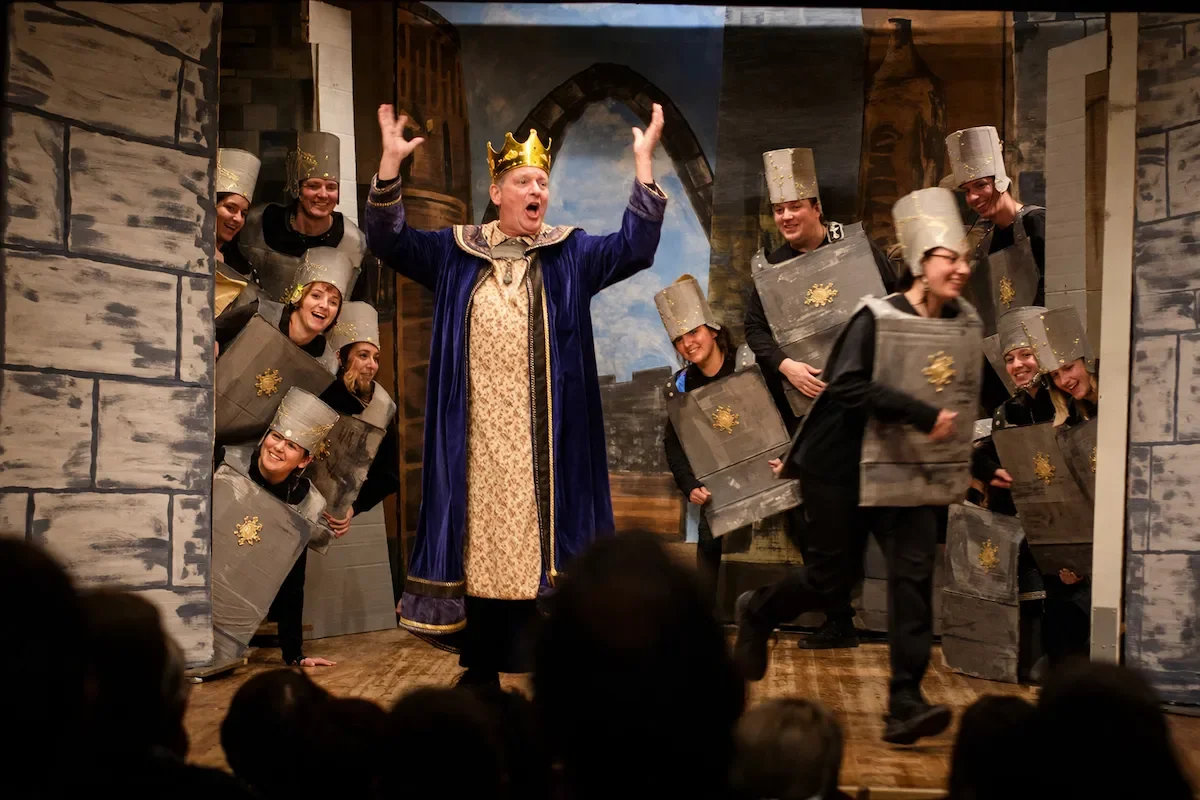
King Duncan is touring the kingdom in alphabetical order and collecting rent while he is at it. His running gag needs understanding before you block it, because it is also a plot mechanism. Irritated by two guards who will not leave him alone, he has them arrested, then has the guard who arrested them arrested, and by the end of Scene Three he has dismissed the lot. Twice in Act Two he calls for guards at exactly the moment he needs them and nothing happens.
The scene is written to absorb as much of your ensemble as you can find. Our Author's Notes are explicit that most of them only need to poke their heads on, from as many different directions as possible, entrances through the auditorium included, and that the more guards you have the funnier it gets. The King himself is the straight man of the show and gets the romance with Dame Dotty as his reward.
Jeeves, Billy, Cassio, Chester and Trey
Jeeves is the Beast's butler and the only sane person in the castle, which makes him the one who engineers the dinner that turns the story. He carries a steady run of food puns and shares the songsheet with Brian.
The four supporting roles are the castle furniture, and each is one joke played straight. Cassio is a clock whose hands stuck years ago, so his only line all evening is 'It's five twenty-three pm', including at eight o'clock and including when somebody needs consoling. Billy is a bookcase with a shelf-help section. Chester introduces himself, formally, as Chester Drawers. Trey is a table whose head appears through a trapdoor in the tabletop and who works through end table, side table and periodic table before anyone can stop him.
These four suit members who will enjoy a strong running gag inside a costume rather than a part to learn, and they carry most of the Act Two opening number.
Casting the Beauty and the Beast Pantomime Characters: Who It Suits
With seven principal characters and four supporting roles, plus an Ensemble of townsfolk, guards, furniture and ghosts, this is the smallest principal cast in the catalogue and sits among our pantomime scripts for small casts. The next smallest is Hansel and Gretel at eight, if you are shortlisting by numbers. The band counts named characters, not bodies, and the guards scene means a company of almost any size can still fill the stage. Everything else we publish is on our All Scripts page, and our home page opens onto the rest of the site.
St Martin's Players found it did exactly that job: ‘We set about reviving the group after Covid and initially found it hard to find a script with a small cast but yours was perfect for the number we had.’
If your membership is thinner than you would like this year, read Scene Three first and count the heads you can get onstage. Request a free Perusal Script, or visit the Beauty and the Beast script page for the full synopsis and details. Our Performance Licences page covers the booking side when you get there.