
Aladdin Pantomime Characters: A Complete Guide
Most Aladdin pantomime characters have been fixed in place for well over a century: a Widow Twankey up to her elbows in someone else’s washing, a Wishee Washee causing chaos beside her, an Abanazar sweeping on to be booed. Ours keeps every one of them, then adds a second genie who has never met the first and a smart speaker with firm views on data protection. Here’s who does what, and what each part asks of the performer you hand it to.
Aladdin and Wishee Washee
Aladdin is the title role and the romantic lead, a good-natured young man who is, in his own mother’s words, ‘a good boy most of the time but he can’t stay out of trouble’. He’s brave when it counts and hopeless with a plan, and he’s smitten with Princess Jasmine from the moment he sees her. The script doesn’t waste any time hiding it, which is exactly what a confessional panto love song is for.
Wishee Washee, Aladdin’s brother, does most of the heavy lifting comedically. He opens the show talking straight to the audience, keeps up a steady stream of one-liners throughout, and gets far too involved in the classic bits of panto business his mother sets running. For anyone new to the title, he is traditionally Widow Twankey’s other son and the comic engine of the whole show, and our version keeps that job description exactly. You’ll sometimes see him spelled Wishy Washy elsewhere. Same character, same role, different laundrette.
Widow Twankey, the Dame
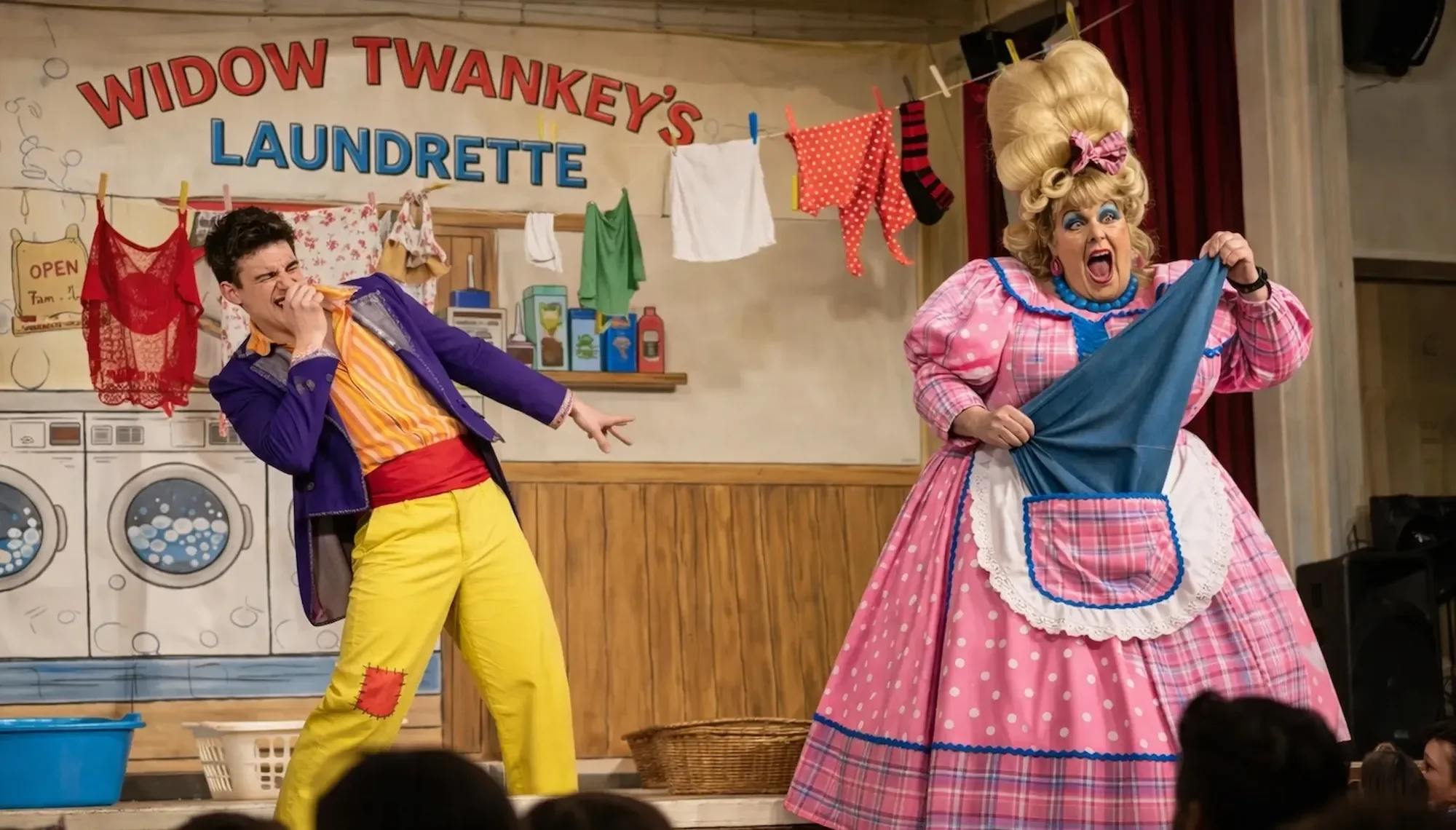
The name Widow Twankey has been gracing Aladdin pantomime scripts for well over a century. It goes back to Twankay, a tea popular in 1860s London, and the laundrette setting is as traditional as the name: Twankey has been washing other people’s clothes on stage for generations. What she does with the job is where our version earns its keep.
Her opening monologue is a proper Dame set piece. A rattling list of who she’s washed for (‘the prince’s pants, the king’s coats and the queen’s qu-ardigans!’, followed by a run of celebrity clients), a comedically emotional description of her loneliness, and a flirtation routine with the audience that ends, inevitably, with a new boyfriend for one night only. Her late husband Francis, who she called Frankie Twankey, supplies the running gag: his denim handkerchief becomes a call and response, and an audience shouting ‘Frankie Twankey’s Manky Hanky!’ back at the stage is not a piece of participation your punters will forget in a hurry. It’s the kind of bit that gets funnier every time it repeats, and it even helps our heroes win the day at the end.
Occupation-led Dames are how we write all of them; the Pantomime Dame guide covers why a job generates more jokes than a frock does.
Abanazar, the villain
Abanazar is the traditional villain of every Aladdin back to the earliest pantomimes, and this version doesn’t soften him. He gets a classic baddie entrance: an evil chord, a direct address inviting the boos, and a warning against getting his name wrong and calling him Ave-a-banana, because ‘It isn’t funny and if you do, you’ll be the one with a split!’ Widow Twankey, obviously, continues to do so for the rest of the scene. He’s a scheming wizard rather than a bumbling baddie, and a great role for someone who loves to wind an audience up.
In our version he sends Aladdin into the cave to fetch the lamp alone, and later, in Act Two, forces Jasmine into an engagement by threatening the Empress. He’s unpleasant when the plot needs him to be. A villain who is actually a threat makes the jokes at his expense funnier, not softer.
Princess Jasmine and the Empress
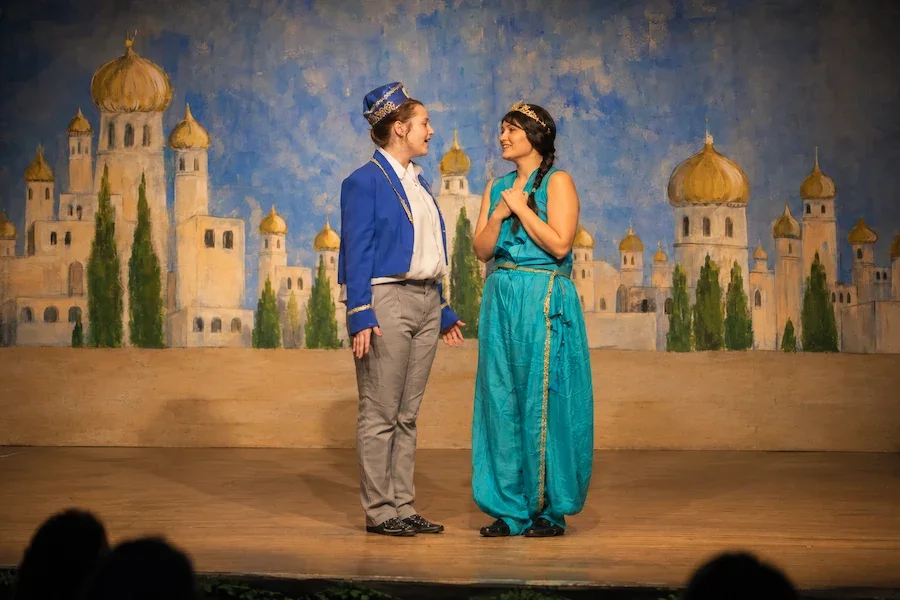
Jasmine has more spine than the average principal girl and isn’t a damsel-in-distress plot device. From the off she actively rejects a parade of absent, invisible and otherwise hopeless princes, and she’s upfront about wanting to marry for love rather than rank. The Empress, her mother, is warm and not tyrannical, a woman who wants her daughter settled and who admits by the end of the show that she should have listened to what Jasmine wanted all along. They share a scene where the Empress describes her own journey to marriage, which seems to go on just a little too long before it hits home as one of the most long-winded and groan-worthy jokes in the show. Jasmine and the Empress’s relationship gives the script an emotional beat that isn’t only plot mechanics, and it’s the reason the ending lands as more than a wedding.
Alexa, the Spirit of the Ring
Every Aladdin needs a Spirit of the Ring, traditionally a genie bound to serve whoever rubs it. Ours reimagines her as a smart assistant. Abanazar summons Alexa and gets maddening, algorithmic precision in return: asked for Aladdin’s approximate location she replies ‘I can’t, GDPR I’m afraid’, she recommends a magic carpet with a Prime subscription joke built in, and she gives driving directions in metres rather than mysticism. It’s a clean modern twist on a traditional role, not a replacement for one, and it’s built to be flexible. The part works as a voice-only role if a group is short on cast, or leans further into the joke with an actual AI voice if you want to push it!
The Genie of the Lamp and Jean, Genie of the Jeans
This is where our Aladdin properly departs from tradition. The Genie of the Lamp is a standard you’d expect in any Aladdin, although ours first appears wrapped in a towel and shower cap, mid-toothbrush, annoyed at being summoned without warning after a thousand years off duty. He then calls in a second genie entirely: Jean, the Genie of the Jeans, who lives in any denim going. Jean is dry and unbothered where Genie is pedantic and put-upon, and the two play as an easy double act rather than rivals.
The pay-off is a set-up honoured properly. Genie admits early on that his one unfulfilled wish, after a thousand years of granting everyone else’s, is to become human, and it’s Aladdin who finally grants it in the finale, via Jean, in an unexpected re-summoning.
If a magical double act is what draws you to this title, our other scripts use the device too. Fairy Sparkles in Cinderella and Fairy Haricot in Jack and the Beanstalk both play comic magical support rather than a straight Fairy Godmother.
Casting the Aladdin Pantomime Characters: Who It Suits
Between the nine named principal characters, Aladdin, Jasmine, Wishee Washee, Widow Twankey, the Empress, Abanazar, Alexa, the Genie of the Lamp and Jean, three supporting roles and a flexible ensemble of townsfolk and guards, this sits comfortably among our pantomime scripts for small casts, with room to grow the ensemble for a bigger group. Everything else we publish is on the All Scripts page, and our home page is the fastest way into the rest of the site.
Four of those nine are comic parts, which is an unusual amount of comedy to distribute, and easier to judge with the script in hand. Request a free Perusal Script, or head to the Aladdin script page for the full synopsis and details. When you’re ready to book, our Performance Licences page covers the rest.