
How to Adapt Your Pantomime Script for Your Community
Making a script feel like it was written for your town, because in a way, it was
Every one of our pantomime scripts is written with the expectation that you'll make it your own, not just perform it as printed. That's not a workaround or a licence loophole, it's built into the writing from the start, and using it well can turn a good production into one your audience feels was made specifically for them. This isn't unusual generosity on our part, it's simply how we think a licensed script should work. A group paying to perform a story should be able to make it feel like their own telling of it, not a rigid transcript they're not allowed to deviate from. The flexibility built into the writing is there to be used, not just a legal allowance buried in the small print.
Local names get a bigger laugh than generic ones
One of the simplest, most effective changes a group can make is swapping a placeholder reference for something specific to your own town. In Cinderella, the Master of Ceremonies at the Royal Ball announces a list of alliterative guest names, and the author's notes suggest exactly this: keep the alliteration, but update the names to include nearby towns and local points of interest. The joke works as written, but it lands harder when the audience recognises the reference as their own. The same logic applies anywhere a script references the local council or leaves a gap for a local rival town, village or landmark: a specific reference beats a generic one nearly every time. There's a similar section in Goldilocks and the Three Bears where Baron von Trakmind does the "Not here" gag with Dame Barnum, then Goldilocks, and finally the mysterious Government. This time there's no alliteration, but there are a number of place names required, so all your neighbouring towns can get a look in. It's a great gag as written, but making it local gets it that extra laugh. Other scripts get this treatment too, so feel free to get creative with your location naming.
Cast flexibility is a feature, not an afterthought
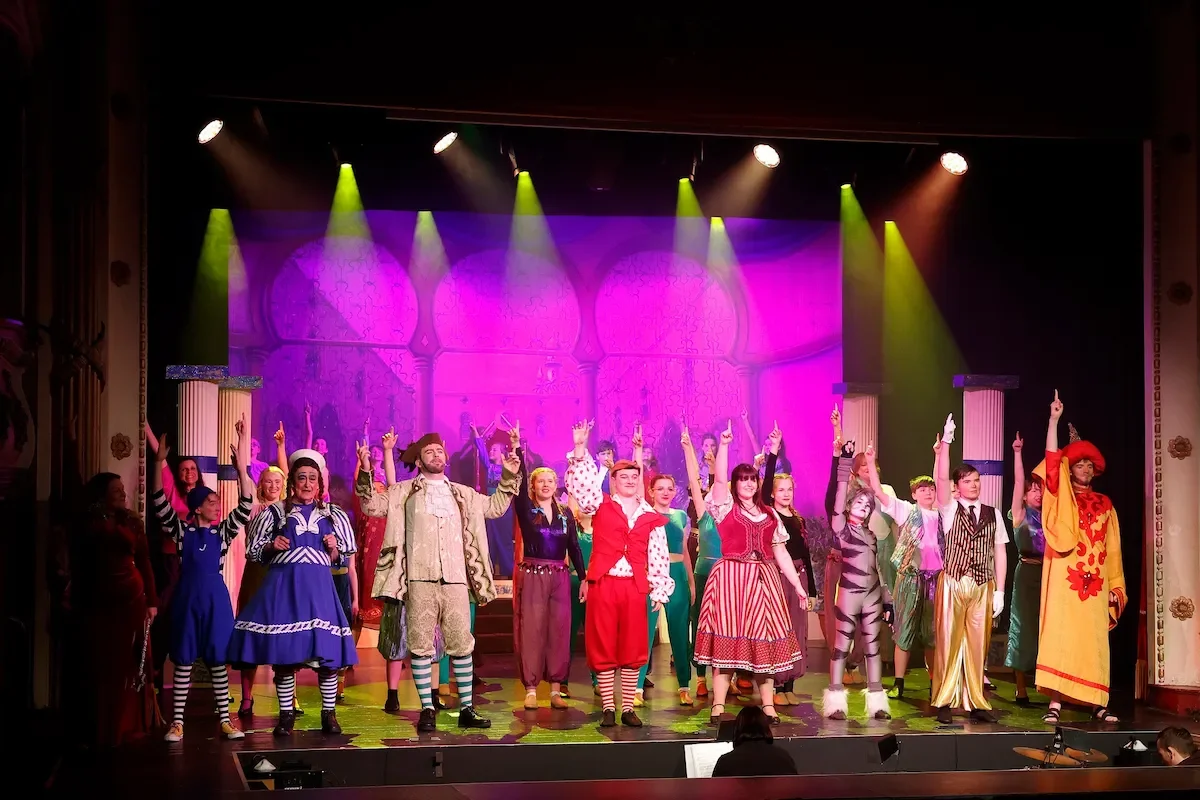
We write roles with deliberately ambiguous characteristics wherever possible, precisely so different groups can cast from their own communities rather than being locked into a narrow template. Character names are chosen to be gender-neutral where the story allows it, and age is only specified in a script when it's central to the comedy or the drama, not as a default assumption. Ensemble lines are written to be split however suits your cast: in Aladdin, the author's notes state plainly that you have permission to increase or decrease how spoken ensemble lines are shared out depending on your casting, which matters just as much for a youth theatre group with 20 keen young performers as it does for a smaller am dram society working with a tight cast list, or a mixed-age community group drawing on everyone from retired members to teenagers. Hansel and Gretel is worth a special mention here. In Act One, there's a scene where customers repeatedly enter Dame Kipling's bakery and leave with a sweet treat each. The part is written for one actor to play all three customers, but if it works better for your cast, it's really easy to make it three separate roles.Changing the season without changing the story
Pantomime is traditionally a Christmas form, but plenty of groups perform in spring or summer instead, and every one of our scripts accounts for that directly. The author's notes across the catalogue give explicit permission to change seasonal Christmas references to whatever's appropriate for your performance dates, so an Easter or summer production doesn't have to feel like a Christmas script performed at the wrong time of year. It's a small line in the notes, but it removes a barrier for groups whose performance calendar doesn't align with the traditional Christmas slot.
Where to draw the line
Adapting a script for your community works best when it's additive rather than structural. Swapping a place name, redistributing ensemble lines, or updating a seasonal reference all work within the shape of the script as written. The same is true of adjusting a song's key or tempo to suit your cast, trimming a scene for time, swapping a specific prop or brand reference for something more familiar to your audience, or reworking a dance break to match your choreographer's strengths. Cutting whole scenes, rewriting a character's core relationships, changing who the villain turns out to be, or altering plot mechanics is a different kind of request. If you're considering something more significant than the adjustments above, it's always worth getting in touch first rather than assuming. All of this, place names, cast splits, seasonal swaps, is already covered under your standard Performance Licence. You don't need to ask permission or pay anything extra to make these kinds of changes as you rehearse and stage the show. If you want to go further and actually rewrite or mark up the script text itself, rather than adjusting it on the fly, that's what the Editable Master Script is for. It gives you an editable copy of the full script to work from directly, and it's available as an add-on alongside your Performance Licence.
Getting the most from your version
The groups that get the most out of one of our scripts tend to be the ones who treat the author's notes as seriously as the dialogue itself, since that's where most of this flexibility is spelled out title by title. If you're choosing your next script with this kind of adaptability in mind, start on our home page to get a feel for the whole catalogue, request a free Perusal Script to see the notes for yourself, or browse our full range of pantomime scripts to compare titles.