
Jack and the Beanstalk Pantomime Characters: A Complete Guide
Much of the comedy in our Jack and the Beanstalk pantomime characters comes from the ordinary, human side of Muddlebrook rather than from the giant. Blunderbore himself stays mostly a voice and a threat, while his mother does the collecting, the negotiating and most of the actual villainy. Below is every named part and what it asks of the performer you give it to.
Jack Trot and Simon Trot
Jack is the principal boy, quietly smitten with Princess Jill from his opening scene and easily wound up by the ensemble teasing it out of him. Simon isn't our invention: 'Simple Simon' as Jack's brother and comic foil is one of the most fixed roles in the wider Jack and the Beanstalk tradition, with the name going back to the 'Simple Simon met a pie-man' nursery rhyme, and he turns up as Jack's sibling in pantomime after pantomime.
What's distinctively ours is what Simon does with the role. His best moment isn't the audience warm-up game it looks like at first. Simon Says starts as a bit of fun in Scene Three, with Simon warning the audience 'there's a catch. You only do it if I say "Simon Says" first', gets forgotten for most of Act One, then returns at the worst possible moment in Blunderbore's castle, where it frees the guards' grip on the rescue party, springs Jack from the dungeon, and finally talks Giant Blunderbore into eating the beans that seal his fate. A running gag that turns out to be the actual plot mechanism is rare, and Simon carries the whole trick.
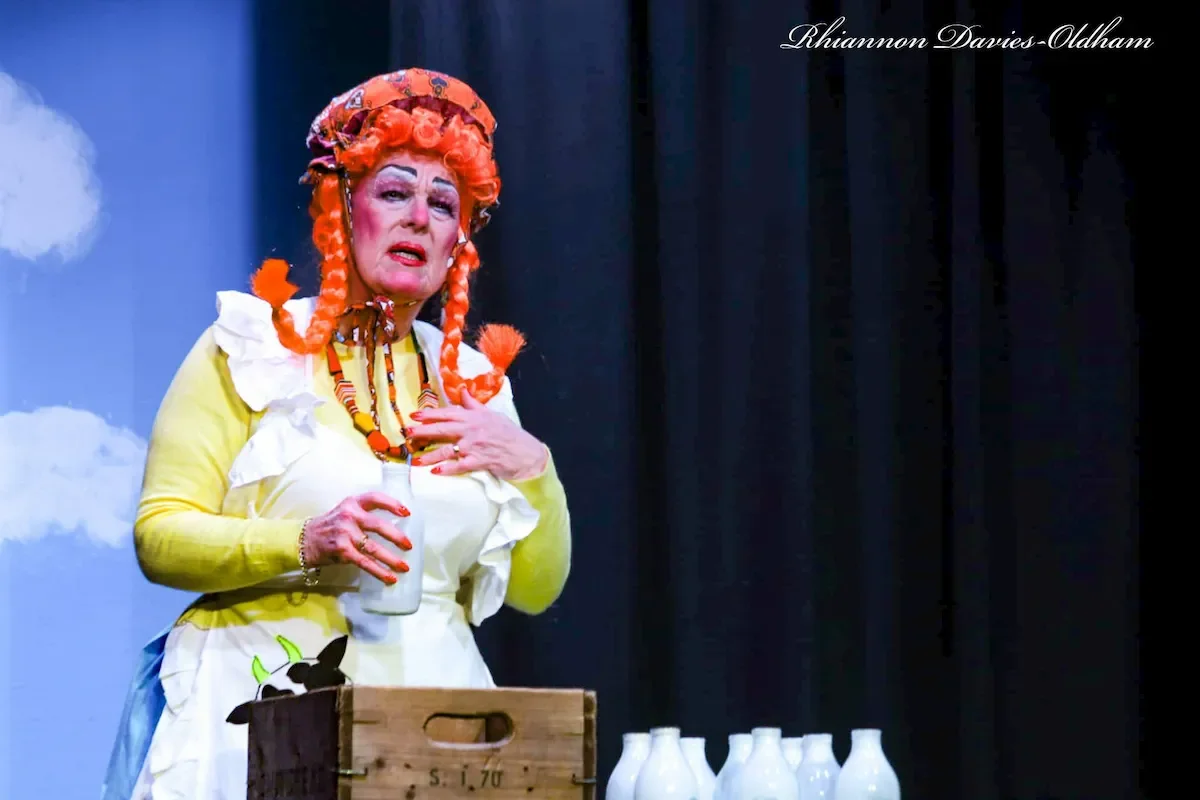
Simon also shares a lovely two-hander with Dame Trot: a milk bottle sorting routine in Scene Three where he reads names from a customer record book and each one doubles as the next word in Dame Trot's story about how she met their late father. It rewards a pair of actors who can build comic rhythm together, not just trade lines. If sibling pairings are what draws you to a script, Beauty and Brian in Beauty and the Beast and Fairy Liquid and Fairy Solid in Pinocchio work on similar ground.
Dame Trot
Traditional panto has Jack's mother as the Dame, usually named Dame Trot, and this version sits squarely inside that convention while giving her a proper job to do it through. She runs the dairy, and the milk round supplies half her material. The Pantomime Dame guide covers why we give every Dame a trade rather than a costume.
Her best device is 'I've got the feels', the cue line the cast agree on in Scene One, with Princess Jill supplying the response: 'You're a fox, Trot!' It's set up as a simple confidence-boosting bit, and then used twice for real stakes later: once to face down a ghost on the beanstalk, where she scares it off rather than the other way round, and again to talk the Giant into eating a tin of baked beans. By Act Two the gag is doing real work, which is more than most audience participation bits manage.
Mrs Blunderbore and Giant Blunderbore
Blunderbore is the traditional name for the giant at the top of the beanstalk, borrowed originally from Jack the Giant Killer and carried into pantomime so long ago that most audiences take it for granted. This script keeps that name for the giant himself but hands most of the onstage villainy to his mother, Mrs Blunderbore. It gives you two baddies who frighten the other characters in different ways, and a dynamic between them. Traditionally the Giant has a sidekick named Fleshcreep; making Mrs Blunderbore an equal, arguably greater, villain instead gives her real agency and lets her drive the wickedness herself, rather than falling back on the idiot henchman so many panto scripts rely on.
Mrs Blunderbore is the better part for it. She delivers the tax demands, negotiates the 'double instead of triple' logic that somehow makes bad news sound like a favour, and stays gleefully pleased with her own wickedness throughout ('I do enjoy being bad, so wonderfully, excellently, deliciously bad!'). Her best exchange is with Princess Jill, who objects that 'it's the 21st century. I'll choose who I'll marry, myself!' and gets the reply: 'You don't get a say either. Well, you can say no if you want to, but the last person to say no to my boy ended up in a stew, and I don't mean emotionally.' Keeping the Giant himself mostly a voice and a rare entrance makes him land harder when he does appear, and gives a smaller group an easier build than a fully costumed giant throughout.
King Harold, Princess Jill and Rowena Ratzi
King Harold is pompous in the traditional panto monarch mould, entering with 'Hello everybody, it is lovely to see me!', and he gets one of the script's better slow-burn arcs. He starts the show flirting badly with his own jokes and ends it proposing to Dame Trot, having spent two acts falling for her one dreadful pun at a time. Jill pushes back on both her father and Mrs Blunderbore in the same scene, and gets her own quiet character beat too: held captive with Pat the cow, she vows to go vegan if she makes it home alive.
Rowena Ratzi, the Royal Reporter, is completely original to this version, and she threads through nearly every scene with a running 'breaking news' bit, most of it wildly overblown for what has actually happened. She is also the one who delivers the Giant's terms to the court in Scene One, so whoever plays her has to land exposition and comedy in the same breath. It all pays off right at the end, when the King asks what inspired her to go into journalism and she reveals her father was a royal photographer called Pappa Ratzi, a joke that has been quietly getting itself ready for the whole show without anyone noticing the setup.
Pat the Cow and Fairy Haricot
Pat is written to be played by two actors sharing one cow costume, a reliable source of physical comedy that needs no dialogue to land, and she's given a genuine say in her own fate when Mrs Blunderbore tries to claim her for the giant's wedding feast, right down to a moo that everyone present agrees is a firm no.
Fairy Haricot and her Bean-Sprites supply the fantastical side of the story once the beanstalk takes hold, working closer to comic sidekick than solemn guide, in the same mould as Fairy Sparkles in Cinderella.
Who These Jack and the Beanstalk Characters Suit
With nine named principal characters, plus Pat the Cow as a two-person part and a flexible ensemble of townsfolk, bean-sprites and monsters, this is one of our small cast scripts. If you're comparing titles, the full catalogue is on our All Scripts page and our home page will point you at everything else.
► Simon Says only works if the audience has been properly taught it in Act One, so read the scene before you decide who plays Simon. Request a free Perusal Script, or visit the Jack and the Beanstalk script page for the full synopsis and a script excerpt. Our Performance Licences page has the details when you're ready to book.