
Tips for how to get your Goldilocks casting ‘just right’
The Goldilocks and the Three Bears pantomime characters in our version do not all come from the original fairytale, because the whole show is set in a circus. Dame Bernie Barnum runs it, the titular Goldilocks does more of the plot-driving than the title suggests, and a twin clown double-act keeps the audience guessing to the finale. Below is every named part, big and small, and what each one brings to the stage.
Dame Bernie Barnum and Goldilocks
A Dame who is Goldilocks' mother, reimagined as a circus owner, is a well-established modern convention for this title, not something unique to our version. Our Dame Bernie Barnum runs Barnum's Circus alone since her late husband died in a Big Top fire years earlier, and the whole plot turns on saving it from Madam Meanie. She has a catchphrase built for audience participation, 'Help me, help me,' answered every time with 'Big breaths, Bernie,' and it gets used whenever she needs courage, facing the Baron, facing the bears, or deciding whether to sign a Contract she really shouldn't. Her daughter Goldilocks does more of the actual plot-driving than the title suggests: she rallies the circus, spots that Meanie's sudden friendliness is 'too easy,' and leads the search into the forest herself. The circus setting recurs elsewhere in the catalogue too, our Pinocchio sends its title puppet into the Circus of Wonders, though the two shows use it very differently.
Ringo the Ringmaster and Baron von Trakmind
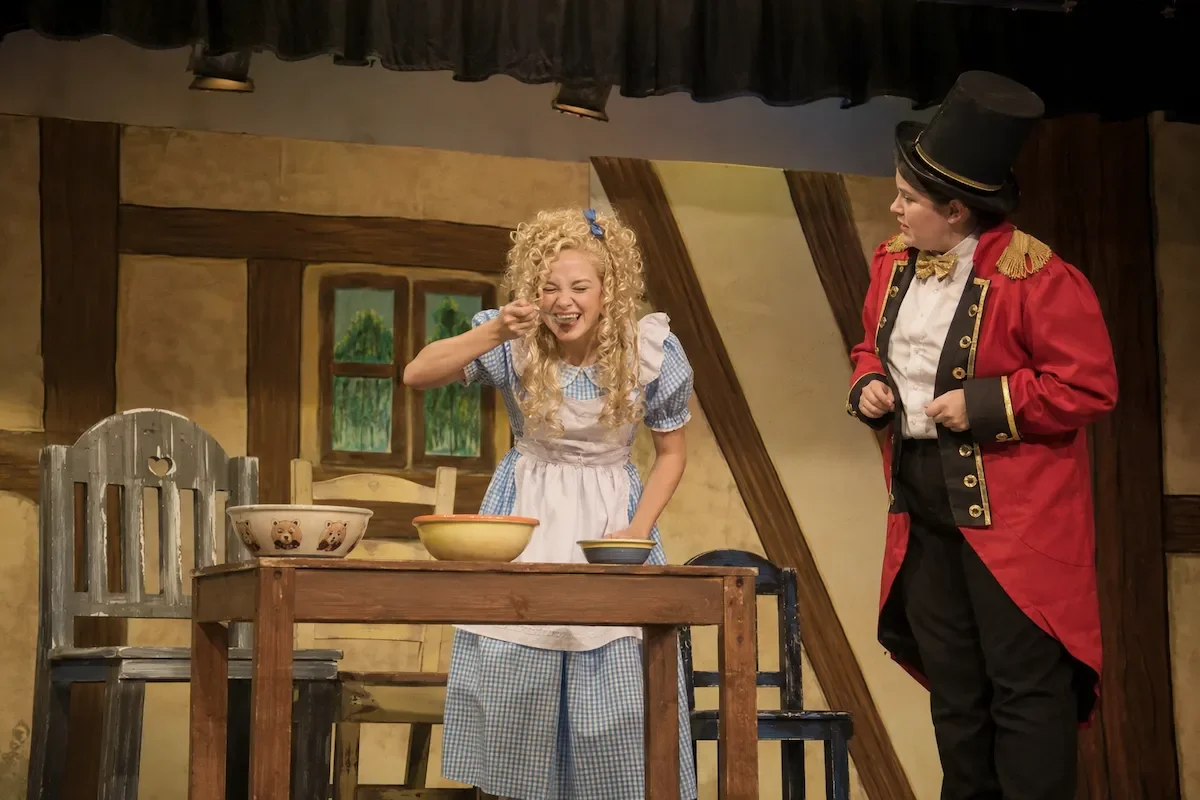
Ringo has no traditional convention to weigh against, he is entirely of the circus setting rather than the folk tale. He introduces the acts in Scene One, keeps spirits up once Meanie takes over, and is the one who volunteers to go with Goldilocks into the forest. He also gets to tease Dame Barnum's romance with the Baron before it becomes anyone else's business.
No traditional convention applies here, the Baron is built purely for this circus setting. He arrives to collect Dame Barnum's rent and spends most of his stage time on a running 'I'm not here' bit he tries on everyone he meets, before it becomes clear he is smitten with Dame Barnum. By the close of the show he is her co-owner, and the final 'wedding bells' tease suggests there may be more to come. Much like Queenie and King Roland in Sleeping Beauty, the romance between the Baron and the Dame requires your actors to go full throttle which enhances the comedy and is great fun for your audience.
Both of these characters are key in driving the plot, and are NLP inventions with plenty to do to keep things moving. While they have some hilariously funny moments, Ringo and the Baron are the straight-men of the show and keep everything tied together.
Charlie and Cooper, the Twin Clowns
Identical twins, one performer and a costumed double, with a red wig and a blue wig kept strictly consistent throughout so the audience always knows who is who even when the characters onstage don't. Their running feud over who is in charge of the new Custard Pie Machine escalates into a full walkout before resolving in a reconciliation and a joint role as Co-Custard-Captains, the pair whose machine ultimately exposes Madam Meanie's fraud. It is not a traditional device so much as a distinctly circus-flavoured spin on the resident-clown role. NLP scripts like a comic double act, and Robin Hood's Bluff and Blunder work a similar rhythm, though there it plays out in banter rather than a body-double illusion.
Madam Meanie and Bean
Goldilocks and the Three Bears has no single fixed panto villain the way Cinderella or Jack and the Beanstalk do, so Madam Meanie is entirely our own invention. Her weapon of choice is magical paper: any contract written on it can be silently rewritten after signing, right up until Fairy Featherwings works out how to stop it. Bean is her put-upon, none-too-bright sidekick and takes most of her best insults on the chin, 'you're a half-wit and you're half-baked, Bean' among them. A dim, apologetic henchman propping up a scheming villain is not new to this catalogue either, Dick Whittington's King Rat keeps Frank and Sammy for much the same job.
Fairy Featherwings
Featherwings speaks entirely in rhyming couplets, gets teased for it constantly, and is the one who eventually works out the loophole, cover the magical paper in dairy, that finally breaks Meanie's contract for good. She is knocked out of an entire scene by a flying cat when Meanie briefly rewrites her out of the script altogether, one of the show's more knowing running gags. Comparable to The Spirit of the Sea in The Little Mermaid, this fairy keeps things moving and the audience right up to date.
The Government
An entirely invented device: a personified tax official who turns up whenever rent or tax is due, announced each time by a running three-beat sting the cast and audience both know is coming. It is the Government who delivers the actual resolution, arresting Meanie for fraud once the Custard Pie Machine reveals what the contract really says. Much like Flummox in Pinocchio, The Government is best played with complete confidence and authority and requires someone who can keep a straight face in the midst of some classic panto chaos.
Daddy Bear, Mummy Bear and Baby Bear
The porridge, chairs and beds sequence is the one piece of structure every version of this tale keeps, and Scene Eight plays it straight before folding the Bears into the wider circus plot. Baby Bear's honey obsession runs the length of the show and ultimately saves it, a clause on Meanie's contract flips ownership to 'the most honey-loving, dance-obsessed and undeniably cute member of the circus,' and Baby Bear claims it on the spot. Daddy Bear's Paddington adjacent weakness for marmalade sandwiches is the actual price of admission for getting the family to join the circus at all.
Barnum's Other Circus Acts: Sampson, Jessie and Psychic Cheryl
Each of these is introduced as an act that undercuts its own billing: Sampson the strongman who isn't strong, Jessie the juggler who drops everything, and Psychic Cheryl, whose predictions are reliably wrong right up until the one that finally lands. None of the three carries plot weight, but each has a well-placed running gag, useful named roles for a group with strong character performers who don't need a big vocal part.
Casting the Goldilocks and the Three Bears Pantomime Characters: Who It Suits
This is a Medium cast script, 13 principal characters across a wide range of ages and skills, from the Dame and villain down to a trio of circus acts built for smaller comic parts, plus three further supporting roles and plenty for your ensemble. It suits a group with a strong Dame and a confident villain, but it particularly rewards a company with one performer capable of playing both Charlie and Cooper convincingly, and a second who can double as their silent partner. It's a fantastic script for societies with a bigger membership to draw on, and if anyone in your group has any circus skills, this is the perfect time to give them a cameo. If you're weighing it up against the rest of the catalogue, our full range of pantomime scripts is worth a browse too.
Branching Out Drama Society summed it up well: ‘I was able to add our own music and a few extras as characters with an added line here or there to accommodate our inclusive group. Nick made the process of ordering the script and personal contact a very easy and pleasant experience and that helped immensely.’
If this cast list sounds like a good fit, request a free Perusal Script or visit the Goldilocks and the Three Bears script page for the full synopsis and details. When you’re ready to book, our Performance Licences page covers what you need, and our home page is the way into everything else.